
One Branch Is Overstocked, Another Is Losing Sales: How POS Stock Transfers Balance Multi-Store Inventory
Moving stock between branches looks simple, but poor transfer control creates phantom inventory, duplicate availability, missing cartons, delayed receiving, and unreliable reports. Learn how a modern POS should request, ship, receive, reconcile, and analyze inter-branch transfers.
One Branch Is Overstocked, Another Is Losing Sales: How POS Stock Transfers Balance Multi-Store Inventory
Moving stock between branches looks simple, but poor transfer control creates phantom inventory, duplicate availability, missing cartons, delayed receiving, and unreliable reports. Learn how a modern POS should request, ship, receive, reconcile, and analyze inter-branch transfers.
A Transfer Is a Controlled Inventory Journey
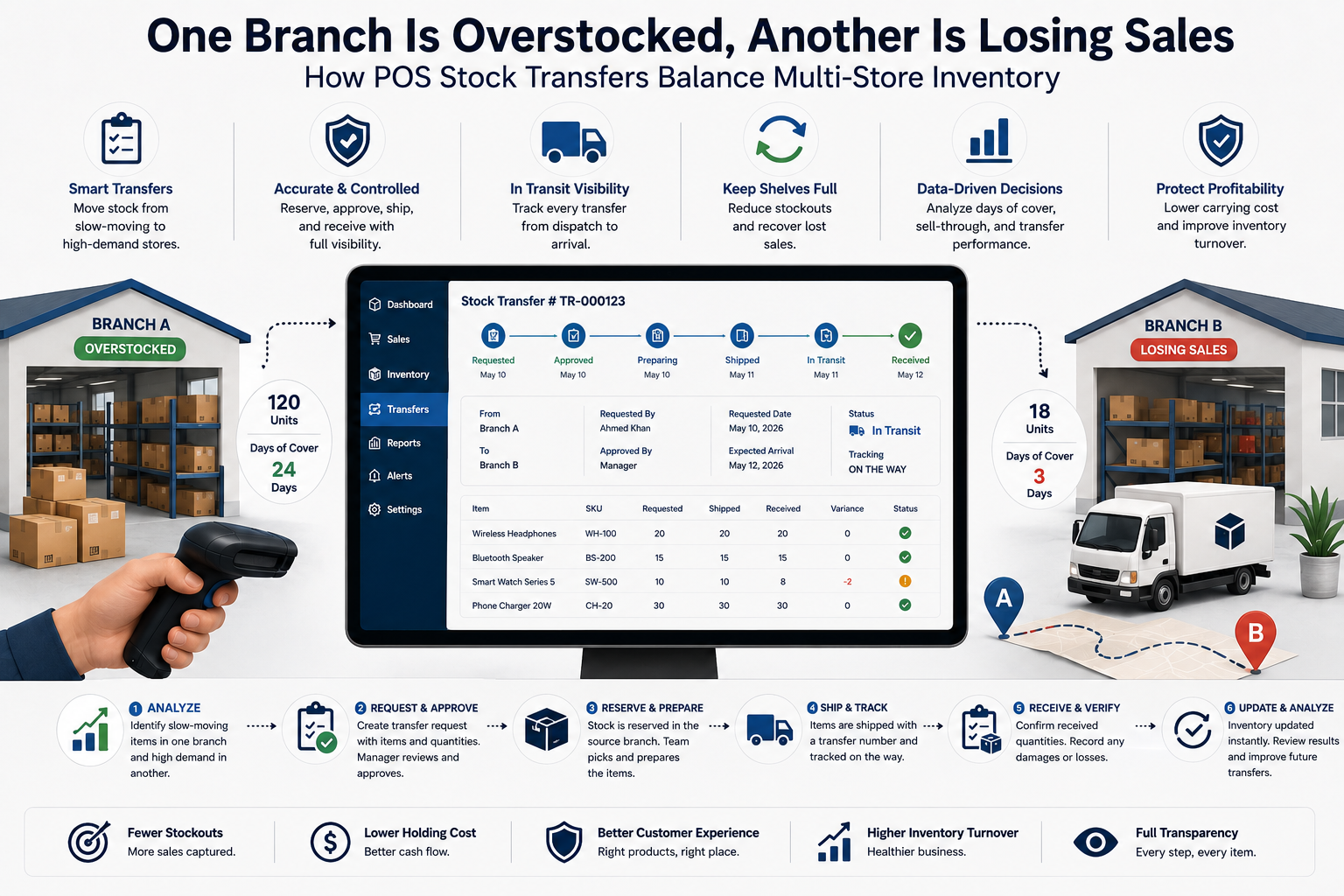
A stock transfer is not a casual message asking another branch to send five units. It is an inventory transaction with a source, destination, item list, quantities, requester, approver, shipment, receiving event, and final reconciliation.
When transfers are handled through calls, chat, or handwritten notes, both branches may believe the same goods are available. The source forgets to deduct them, the destination adds them before arrival, and reports show inventory that exists in two places at once.
For example, A stock transfer is not a casual message asking another branch to send five units. It is an inventory transaction with a source, destination, item list, quantities, requester, approver, shipment, receiving event, and final reconciliation. The exact timing depends on the workflow, but the rule must be consistent. If stock is deducted only after the destination receives it, the source may oversell. If the destination receives it before physical arrival, customers may be promised goods that are still on the road. The workflow should be tested with a partial shipment, a damaged carton, a cancelled request, a delayed arrival, and a receiving quantity that differs from the dispatch quantity.
The Source Branch Must Lose Availability at the Right Moment
The source branch should reserve requested units so they are not sold while staff prepare the transfer. When the shipment leaves, those units should move from available stock into an in-transit status rather than disappearing from the network.
The exact timing depends on the workflow, but the rule must be consistent. If stock is deducted only after the destination receives it, the source may oversell. If the destination receives it before physical arrival, customers may be promised goods that are still on the road.
For example, The exact timing depends on the workflow, but the rule must be consistent. If stock is deducted only after the destination receives it, the source may oversell. If the destination receives it before physical arrival, customers may be promised goods that are still on the road. The receiving branch should scan or count what actually arrives. A carton may be short, damaged, substituted, or split across multiple deliveries. Automatically accepting the planned quantity hides loss and pushes the discrepancy into the next stocktake. The workflow should be tested with a partial shipment, a damaged carton, a cancelled request, a delayed arrival, and a receiving quantity that differs from the dispatch quantity.
Stock in Transit Needs Its Own Status
Inventory in transit is still owned by the business but is not currently sellable at either branch. It needs transfer number, origin, destination, carrier or employee, dispatch time, expected arrival, quantities, cost, and status.
Statuses such as requested, approved, picking, packed, dispatched, partially received, received, cancelled, and disputed make the journey visible. Delayed transfers should trigger follow-up rather than remaining open indefinitely.
For example, When transfers are handled through calls, chat, or handwritten notes, both branches may believe the same goods are available. The source forgets to deduct them, the destination adds them before arrival, and reports show inventory that exists in two places at once. Transfers should solve a demand problem. Use sales velocity, days of cover, current reservations, local events, seasonality, stockouts, incoming purchase orders, and the source branch’s remaining needs before moving products. The workflow should be tested with a partial shipment, a damaged carton, a cancelled request, a delayed arrival, and a receiving quantity that differs from the dispatch quantity.
The Receiving Branch Must Confirm What Actually Arrived
The receiving branch should scan or count what actually arrives. A carton may be short, damaged, substituted, or split across multiple deliveries. Automatically accepting the planned quantity hides loss and pushes the discrepancy into the next stocktake.
Record received quantity, damaged quantity, missing quantity, receiving user, time, notes, and evidence when needed. The system should reconcile source shipment with destination receipt and create an exception for any difference.
For example, Inventory in transit is still owned by the business but is not currently sellable at either branch. It needs transfer number, origin, destination, carrier or employee, dispatch time, expected arrival, quantities, cost, and status. Dashierly or any POS should treat every transfer as a documented chain of custody. The goal is to move the right stock quickly without creating phantom quantities, weakening accountability, or solving one branch’s shortage by creating another. The workflow should be tested with a partial shipment, a damaged carton, a cancelled request, a delayed arrival, and a receiving quantity that differs from the dispatch quantity.
Transfer Decisions Should Follow Demand, Not Politics
Transfers should solve a demand problem. Use sales velocity, days of cover, current reservations, local events, seasonality, stockouts, incoming purchase orders, and the source branch’s remaining needs before moving products.
A branch with ten units is not necessarily able to spare eight. Central management should avoid using the loudest request as the replenishment rule and instead compare network-wide demand and service levels.
For example, The source branch should reserve requested units so they are not sold while staff prepare the transfer. When the shipment leaves, those units should move from available stock into an in-transit status rather than disappearing from the network. When transfers are handled through calls, chat, or handwritten notes, both branches may believe the same goods are available. The source forgets to deduct them, the destination adds them before arrival, and reports show inventory that exists in two places at once. The workflow should be tested with a partial shipment, a damaged carton, a cancelled request, a delayed arrival, and a receiving quantity that differs from the dispatch quantity.
Use Transfer Performance to Improve the Network
Measure request-to-dispatch time, transit time, fill rate, receiving variance, transfer cost, emergency transfers, aged open transfers, stockout reduction, and sales recovered at the destination.
Dashierly or any POS should treat every transfer as a documented chain of custody. The goal is to move the right stock quickly without creating phantom quantities, weakening accountability, or solving one branch’s shortage by creating another.
For example, Statuses such as requested, approved, picking, packed, dispatched, partially received, received, cancelled, and disputed make the journey visible. Delayed transfers should trigger follow-up rather than remaining open indefinitely. Inventory in transit is still owned by the business but is not currently sellable at either branch. It needs transfer number, origin, destination, carrier or employee, dispatch time, expected arrival, quantities, cost, and status. The workflow should be tested with a partial shipment, a damaged carton, a cancelled request, a delayed arrival, and a receiving quantity that differs from the dispatch quantity.
Keep reading
The Customer Paid a Deposit, but the Sale Is Not Finished: How POS Systems Should Manage Preorders, Layaway, and Partial Payments
Deposits, preorders, layaway, special orders, and partial payments can secure demand and improve cash flow—but only when inventory, customer balances, due dates, refunds, and accounting stay connected. Learn how a modern POS should manage the entire order lifecycle.
Read article
The Drawer Is Short at Closing—What Happened? How POS Shift Reconciliation Finds Cash Errors Before They Repeat
Cash shortages and overages are rarely solved by simply blaming the cashier. A reliable POS should connect opening floats, cash sales, refunds, payouts, drops, tips, drawer access, shift handovers, and closing counts. Learn how to reconcile every shift and turn differences into process improvements.
Read article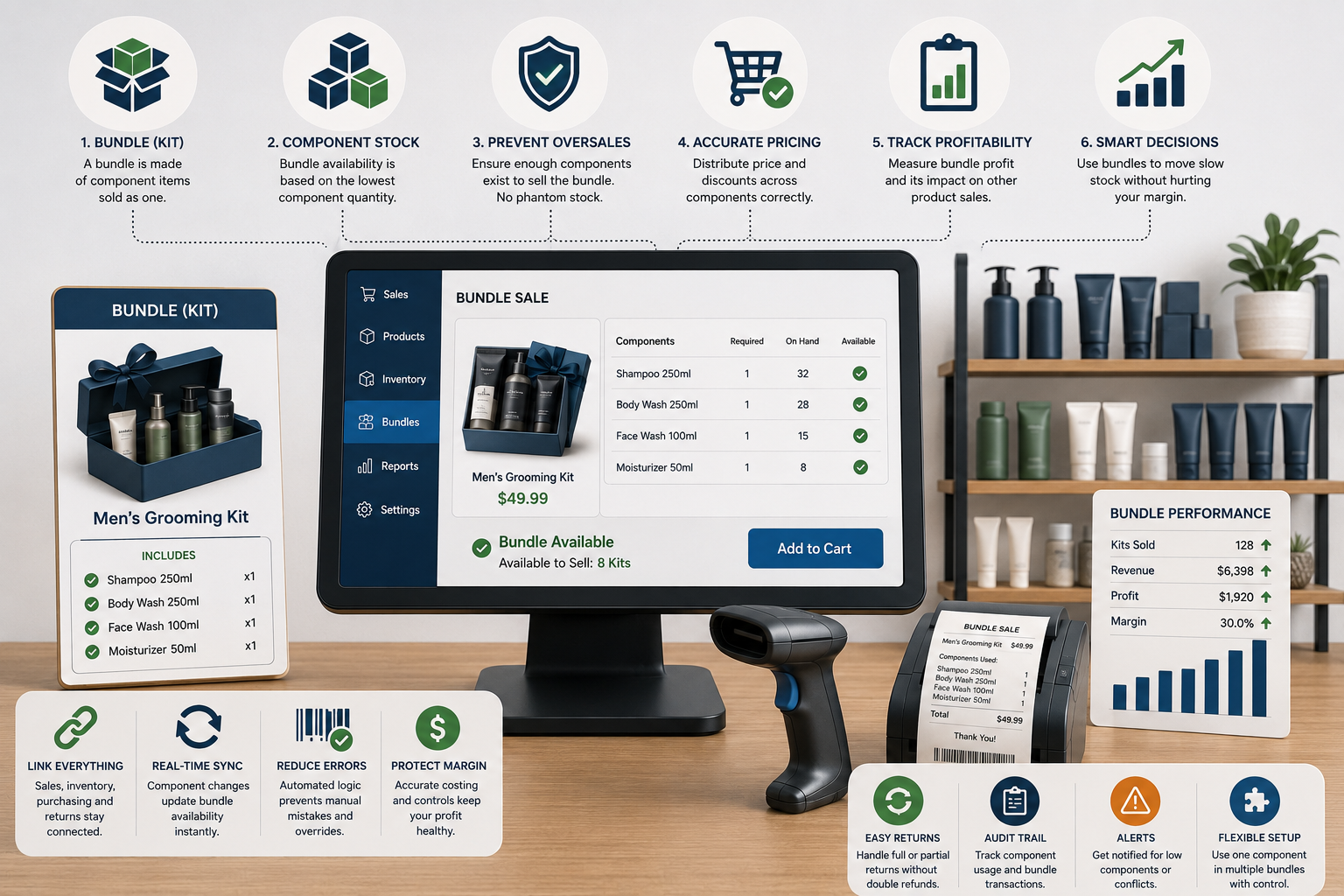
The Bundle Sold Out, but Every Item Is Still on the Shelf: How POS Systems Should Manage Kits, Multipacks, and Component Stock
Bundles can raise basket value, simplify buying, and move slow stock—but poor setup creates phantom availability, overselling, wrong costs, and confusing returns. Learn how POS systems should manage components, pricing, inventory, purchasing, and profitability.
Read article