
Your Inventory Is Not Wrong by Accident: How Product Data, Barcodes, and Variants Shape POS Accuracy
Inventory problems often begin before a sale happens. Learn how duplicate SKUs, shared barcodes, wrong units, poorly designed variants, pack sizes, and inconsistent product data create stock errors—and how a modern POS can prevent them.
Your Inventory Is Not Wrong by Accident: How Product Data, Barcodes, and Variants Shape POS Accuracy
Inventory problems often begin before a sale happens. Learn how duplicate SKUs, shared barcodes, wrong units, poorly designed variants, pack sizes, and inconsistent product data create stock errors—and how a modern POS can prevent them.
The Inventory Error Often Starts in the Product Catalogue
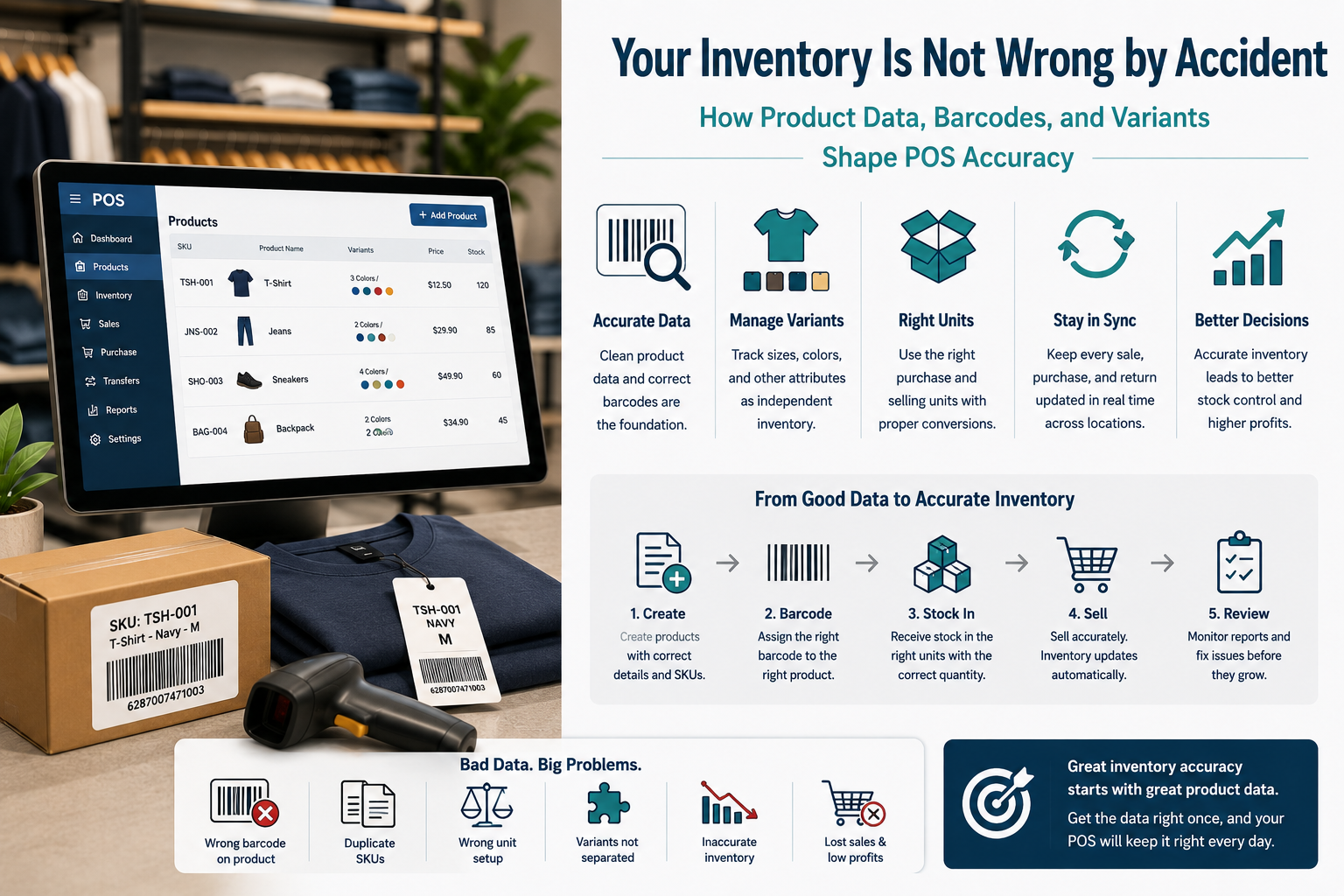
Many retailers blame the cashier, the scanner, or the stock count when the system says twelve units and the shelf holds seven. The real error may have been created weeks earlier when an item was entered twice, a barcode was assigned to the wrong variation, a carton was received as one unit, or a return was posted to a generic product.
The product catalogue is operational infrastructure. Product name, SKU, barcode, category, tax, cost, sell price, supplier, unit, pack size, variation, and location rules all influence what happens at checkout and in inventory reports.
For example, Many retailers blame the cashier, the scanner, or the stock count when the system says twelve units and the shelf holds seven. The real error may have been created weeks earlier when an item was entered twice, a barcode was assigned to the wrong variation, a carton was received as one unit, or a return was posted to a generic product. Retailers may legitimately need more than one scannable code for an item, such as a manufacturer EAN, an old supplier code, and an internal label. The system should support this deliberately while maintaining one clear product or variation identity. The corrective action should change the master record or workflow, not merely adjust the quantity and close the investigation.
A Barcode Is an Identifier, Not the Product Itself
A barcode is a machine-readable identifier that points the POS to a record. It does not guarantee that the record is correct. The same physical barcode connected to two products can make scanning unpredictable; a newly printed internal barcode connected to the wrong SKU can move stock from the wrong line.
Retailers may legitimately need more than one scannable code for an item, such as a manufacturer EAN, an old supplier code, and an internal label. The system should support this deliberately while maintaining one clear product or variation identity.
For example, Retailers may legitimately need more than one scannable code for an item, such as a manufacturer EAN, an old supplier code, and an internal label. The system should support this deliberately while maintaining one clear product or variation identity. A supplier may sell a case of twenty-four cans while the store sells one can. Receiving one case as one unit creates an immediate difference of twenty-three. The same problem appears with kilograms and grams, boxes and pieces, metres and rolls, or products converted during production. The corrective action should change the master record or workflow, not merely adjust the quantity and close the investigation.
Variants Need Their Own Stock Identity
A blue medium shirt is not the same inventory item as a black large shirt. If variants are stored only as text in the product name, receiving, counting, selling, and reordering become fragile.
Each sellable variation should have its own SKU, stock quantity, barcode where appropriate, cost, price, reorder level, and status. The parent product can group the family, but stock decisions belong to the exact variant.
For example, The product catalogue is operational infrastructure. Product name, SKU, barcode, category, tax, cost, sell price, supplier, unit, pack size, variation, and location rules all influence what happens at checkout and in inventory reports. A stocktake can correct the visible quantity today, but it cannot prevent the catalogue from creating the same error tomorrow. If duplicate products, wrong units, shared barcodes, and ambiguous variants remain, every count becomes temporary repair work. The corrective action should change the master record or workflow, not merely adjust the quantity and close the investigation.
Units and Pack Sizes Create Expensive Mistakes
A supplier may sell a case of twenty-four cans while the store sells one can. Receiving one case as one unit creates an immediate difference of twenty-three. The same problem appears with kilograms and grams, boxes and pieces, metres and rolls, or products converted during production.
The POS needs explicit purchasing units, selling units, and conversion factors. Staff should see whether they are receiving cases, inner packs, or individual pieces, and the conversion should be controlled rather than typed from memory.
For example, A blue medium shirt is not the same inventory item as a black large shirt. If variants are stored only as text in the product name, receiving, counting, selling, and reordering become fragile. Dashierly or any POS should make product data easy to create but difficult to corrupt. Accurate inventory is not produced by one annual count. It is produced by thousands of correctly identified transactions. The corrective action should change the master record or workflow, not merely adjust the quantity and close the investigation.
Counting Cannot Repair Bad Master Data
A stocktake can correct the visible quantity today, but it cannot prevent the catalogue from creating the same error tomorrow. If duplicate products, wrong units, shared barcodes, and ambiguous variants remain, every count becomes temporary repair work.
Use count differences as evidence. Group adjustments by reason, product, supplier, employee, branch, and workflow. Repeated differences often reveal a data or process defect rather than random theft or carelessness.
For example, A barcode is a machine-readable identifier that points the POS to a record. It does not guarantee that the record is correct. The same physical barcode connected to two products can make scanning unpredictable; a newly printed internal barcode connected to the wrong SKU can move stock from the wrong line. The product catalogue is operational infrastructure. Product name, SKU, barcode, category, tax, cost, sell price, supplier, unit, pack size, variation, and location rules all influence what happens at checkout and in inventory reports. The corrective action should change the master record or workflow, not merely adjust the quantity and close the investigation.
Build a Product-Data Discipline Around the POS
Create ownership for product creation and editing. Use required fields, duplicate checks, barcode validation, naming rules, controlled categories, unit definitions, and an approval process for sensitive changes.
Dashierly or any POS should make product data easy to create but difficult to corrupt. Accurate inventory is not produced by one annual count. It is produced by thousands of correctly identified transactions.
For example, Each sellable variation should have its own SKU, stock quantity, barcode where appropriate, cost, price, reorder level, and status. The parent product can group the family, but stock decisions belong to the exact variant. A blue medium shirt is not the same inventory item as a black large shirt. If variants are stored only as text in the product name, receiving, counting, selling, and reordering become fragile. The corrective action should change the master record or workflow, not merely adjust the quantity and close the investigation.
Keep reading

The Website Says “In Stock,” but the Shelf Is Empty: How POS Systems Prevent Omnichannel Inventory Failures
Online orders, store sales, pickup reservations, returns, and transfers compete for the same units. Learn how a connected POS protects inventory accuracy, prevents overselling, and keeps click-and-collect promises realistic.
Read article
Who Changed the Price? How POS Permissions and Audit Trails Protect Retail Operations
Retail losses and operational mistakes often begin with shared logins, excessive permissions, and actions that cannot be traced. Learn how role-based access, personal accounts, approvals, and POS audit logs create accountability without slowing the store.
Read article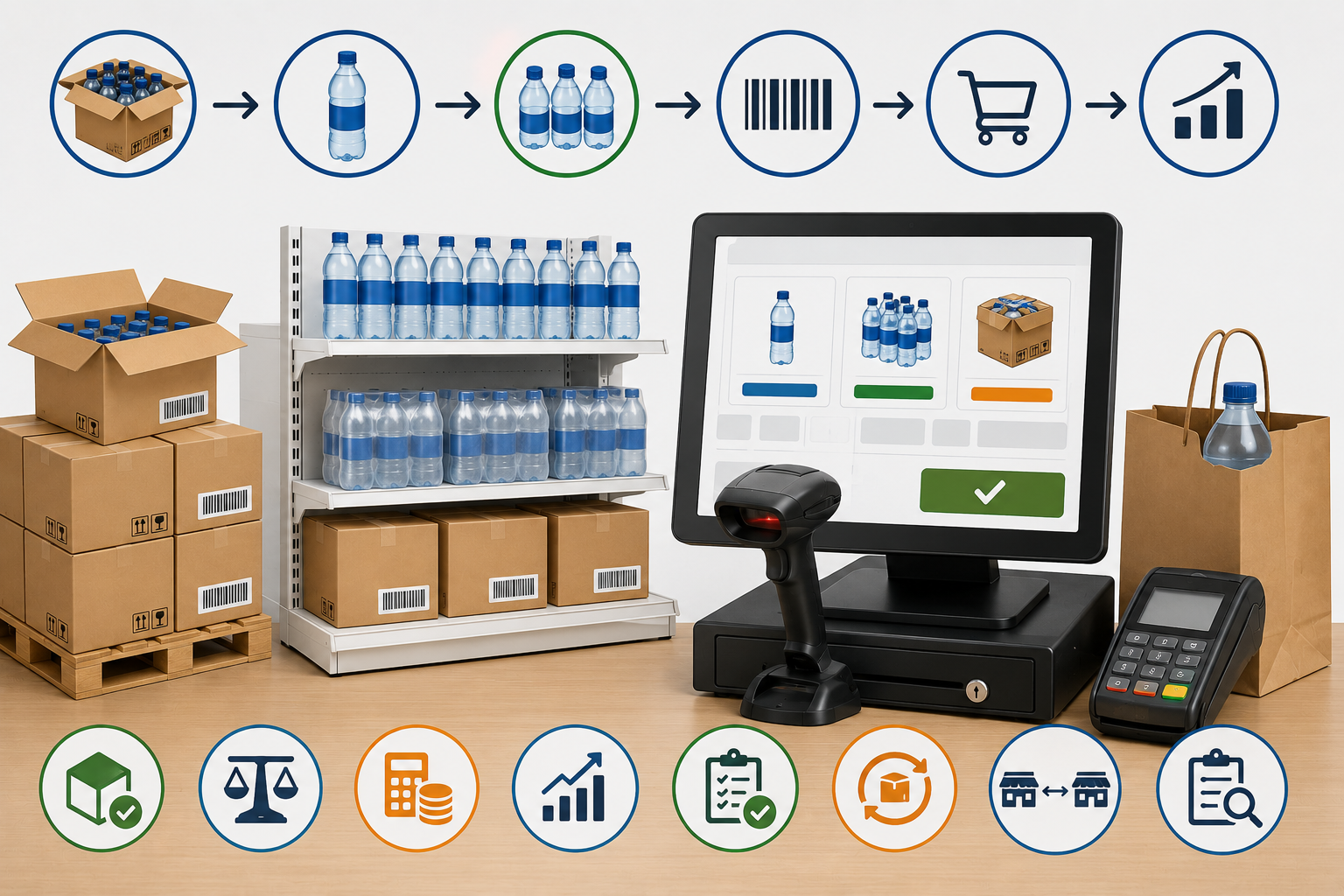
You Bought a Case of 24 but Sold One Bottle: How POS Units of Measure Prevent Inventory and Pricing Errors
Retailers often buy products by case, receive them by pack, and sell them individually. Learn how POS unit-of-measure rules, barcode mapping, cost conversion, stock counts, returns, and purchasing controls prevent quantity and margin errors.
Read article