
The Shelf Says One Price, the POS Charges Another: How Retailers Prevent Price Mismatches and Protect Customer Trust
Price mismatches are more than an awkward checkout moment. They create refunds, complaints, margin leakage, regulatory risk, and lost trust. Learn how a modern POS should synchronize price lists, shelf labels, promotions, branches, taxes, and approvals.
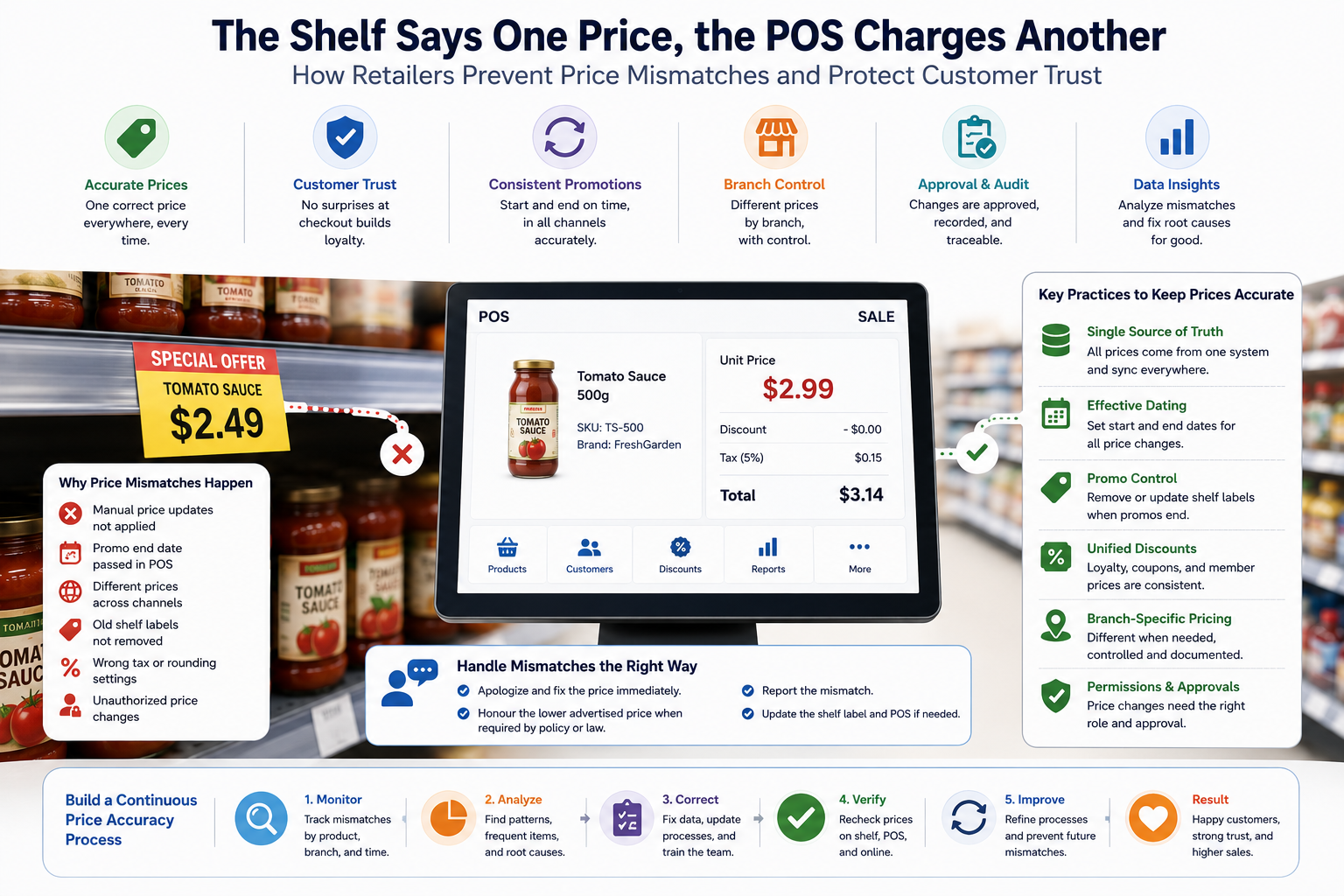
The Shelf Says One Price, the POS Charges Another: How Retailers Prevent Price Mismatches and Protect Customer Trust
Price mismatches are more than an awkward checkout moment. They create refunds, complaints, margin leakage, regulatory risk, and lost trust. Learn how a modern POS should synchronize price lists, shelf labels, promotions, branches, taxes, and approvals.
A Price Is a Rule with a Start, End, Place, and Audience
A retail price is not just a number stored beside a product. It may depend on branch, customer group, quantity, date, time, tax rule, membership, promotion, payment method, channel, or supplier-funded campaign.
When those conditions are not explicit, two systems can make different but apparently reasonable decisions. The shelf label shows the base price, the POS applies a new list, and the website still displays yesterday’s campaign.
For example, A retail price is not just a number stored beside a product. It may depend on branch, customer group, quantity, date, time, tax rule, membership, promotion, payment method, channel, or supplier-funded campaign. Every price change should carry an effective start, end, affected products, locations, customer segments, tax treatment, approval, and publication status. Staff need to know whether a change is drafted, approved, active, expired, or rolled back. The rule should be tested at campaign start, campaign end, in a second branch, with a loyalty customer, and with a manual override before publication.
Shelf Labels Must Follow the Same Source as Checkout
The safest model uses one governed price source that feeds the POS, shelf labels, e-commerce, mobile apps, product lookup, and branch reports. Labels printed from spreadsheets or old exports quickly become disconnected from checkout.
Every price change should carry an effective start, end, affected products, locations, customer segments, tax treatment, approval, and publication status. Staff need to know whether a change is drafted, approved, active, expired, or rolled back.
For example, Every price change should carry an effective start, end, affected products, locations, customer segments, tax treatment, approval, and publication status. Staff need to know whether a change is drafted, approved, active, expired, or rolled back. Multi-branch retailers sometimes need local prices because rent, competition, taxes, supply costs, or regional campaigns differ. Local pricing is legitimate, but uncontrolled edits create confusion and make central reporting unreliable. The rule should be tested at campaign start, campaign end, in a second branch, with a loyalty customer, and with a manual override before publication.
Promotions Fail When Timing and Eligibility Drift
Promotions create the highest risk because timing and eligibility are more complex. A campaign may begin at midnight online but at store opening in branches, or end while old shelf signs remain in place.
The POS should calculate eligibility from the same rules used to publish the sign: product, category, quantity, customer, date, time, branch, coupon, loyalty tier, minimum spend, and combination logic.
For example, When those conditions are not explicit, two systems can make different but apparently reasonable decisions. The shelf label shows the base price, the POS applies a new list, and the website still displays yesterday’s campaign. When a customer shows a lower shelf price, the immediate priority is a fair and fast resolution. Staff may need a controlled override, manager approval, reason code, photo or note, and a corrected label task. The rule should be tested at campaign start, campaign end, in a second branch, with a loyalty customer, and with a manual override before publication.
Branches Need Controlled Local Pricing
Multi-branch retailers sometimes need local prices because rent, competition, taxes, supply costs, or regional campaigns differ. Local pricing is legitimate, but uncontrolled edits create confusion and make central reporting unreliable.
Use approved branch price lists, value limits, scheduled activation, responsible owners, and clear inheritance from the company price. A local manager should not silently change a national product price without a trace.
For example, Promotions create the highest risk because timing and eligibility are more complex. A campaign may begin at midnight online but at store opening in branches, or end while old shelf signs remain in place. Dashierly or any POS should turn pricing into a synchronized workflow: create, approve, publish, verify, sell, monitor, and correct. Price accuracy protects more than margin—it tells customers that the business keeps the promises printed on the shelf. The rule should be tested at campaign start, campaign end, in a second branch, with a loyalty customer, and with a manual override before publication.
Overrides Should Fix the Customer Moment and Reveal the Root Cause
When a customer shows a lower shelf price, the immediate priority is a fair and fast resolution. Staff may need a controlled override, manager approval, reason code, photo or note, and a corrected label task.
The override should not disappear into daily sales. Repeated overrides on the same product, aisle, branch, or promotion reveal broken publishing, late label replacement, training gaps, or unauthorized changes.
For example, The safest model uses one governed price source that feeds the POS, shelf labels, e-commerce, mobile apps, product lookup, and branch reports. Labels printed from spreadsheets or old exports quickly become disconnected from checkout. When those conditions are not explicit, two systems can make different but apparently reasonable decisions. The shelf label shows the base price, the POS applies a new list, and the website still displays yesterday’s campaign. The rule should be tested at campaign start, campaign end, in a second branch, with a loyalty customer, and with a manual override before publication.
For example, Multi-branch retailers sometimes need local prices because rent, competition, taxes, supply costs, or regional campaigns differ. Local pricing is legitimate, but uncontrolled edits create confusion and make central reporting unreliable. The override should not disappear into daily sales. Repeated overrides on the same product, aisle, branch, or promotion reveal broken publishing, late label replacement, training gaps, or unauthorized changes. The rule should be tested at campaign start, campaign end, in a second branch, with a loyalty customer, and with a manual override before publication.
Audit Price Accuracy Before Customers Discover the Error
Run routine price audits using sampled products, high-volume items, new campaigns, recently edited SKUs, branch-specific lists, and products with frequent overrides. Compare shelf, product lookup, website, and checkout values.
Dashierly or any POS should turn pricing into a synchronized workflow: create, approve, publish, verify, sell, monitor, and correct. Price accuracy protects more than margin—it tells customers that the business keeps the promises printed on the shelf.
For example, The POS should calculate eligibility from the same rules used to publish the sign: product, category, quantity, customer, date, time, branch, coupon, loyalty tier, minimum spend, and combination logic. Promotions create the highest risk because timing and eligibility are more complex. A campaign may begin at midnight online but at store opening in branches, or end while old shelf signs remain in place. The rule should be tested at campaign start, campaign end, in a second branch, with a loyalty customer, and with a manual override before publication.
Keep reading
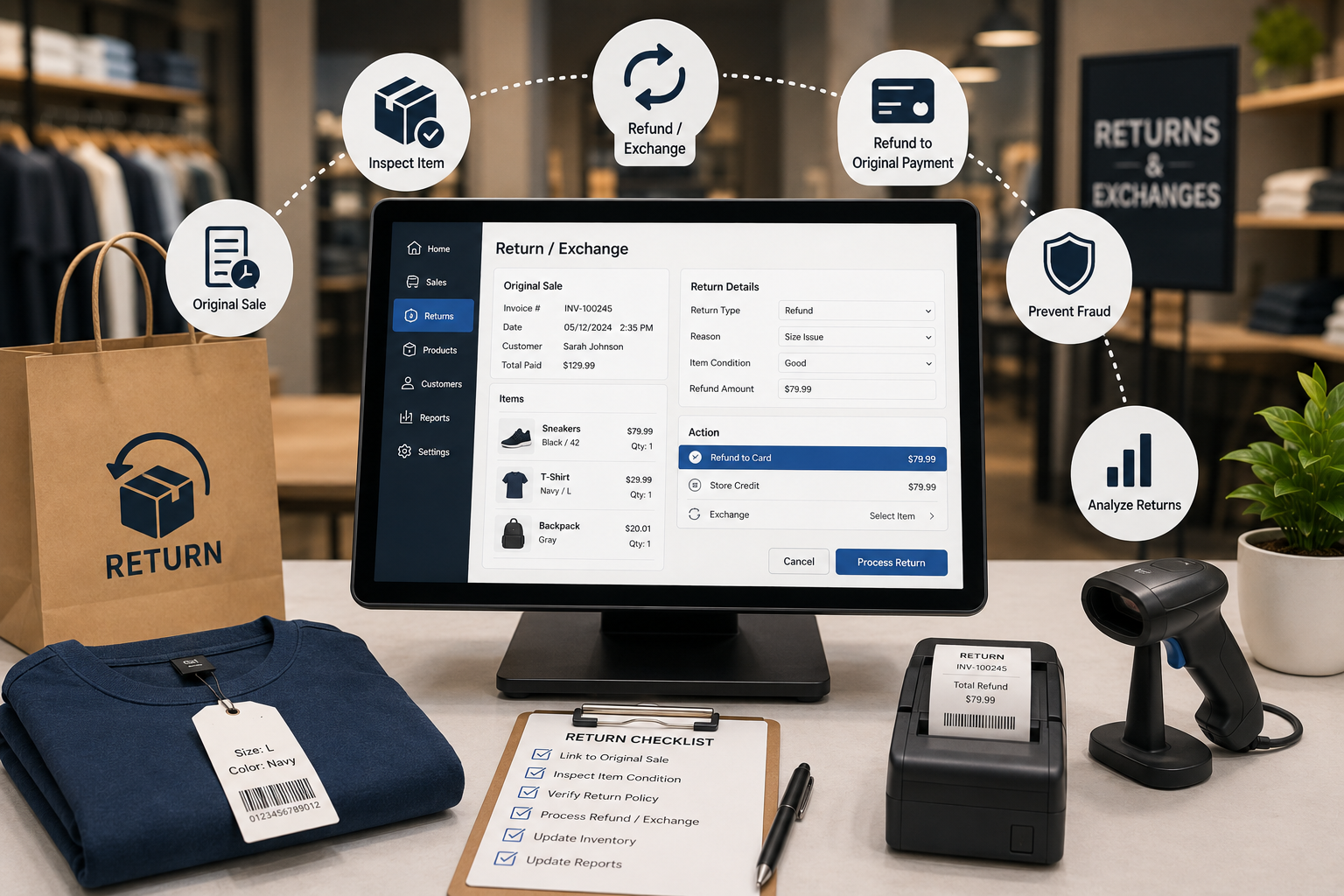
A Return Is Not a Sale in Reverse: How POS Systems Handle Refunds, Exchanges, Restocking, and Return Fraud
Returns affect cash, margin, inventory, tax, customer trust, and fraud exposure. Learn how a modern POS should connect every refund or exchange to the original sale, inspect product condition, control approvals, and keep stock accurate.
Read article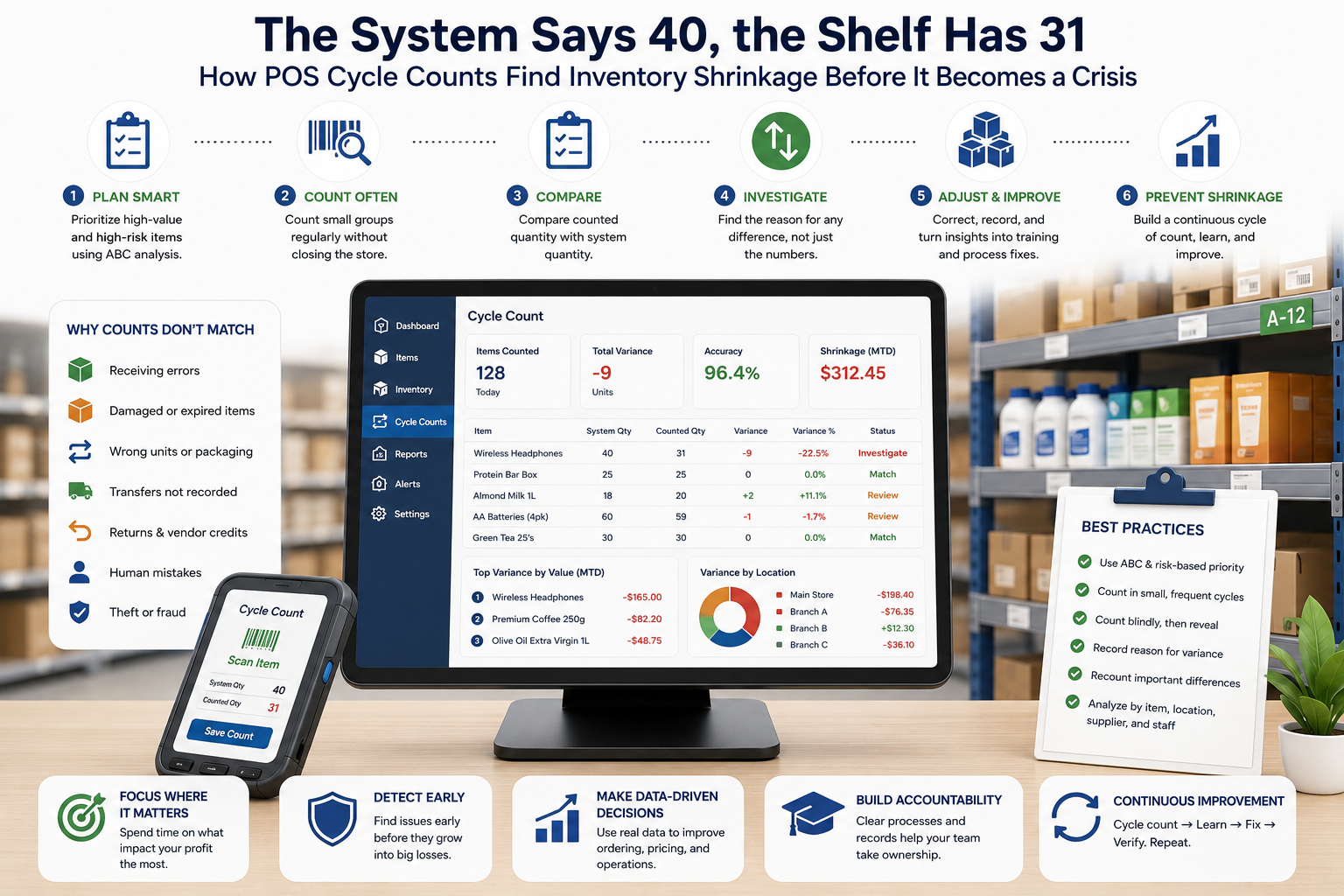
The System Says 40, the Shelf Has 31: How POS Cycle Counts Find Inventory Shrinkage Before It Becomes a Crisis
Inventory discrepancies rarely appear all at once. They build through receiving mistakes, unrecorded damage, wrong units, theft, transfers, returns, and stock adjustments. Learn how POS cycle counts, variance analysis, and root-cause workflows restore accuracy without closing the entire store.
Read article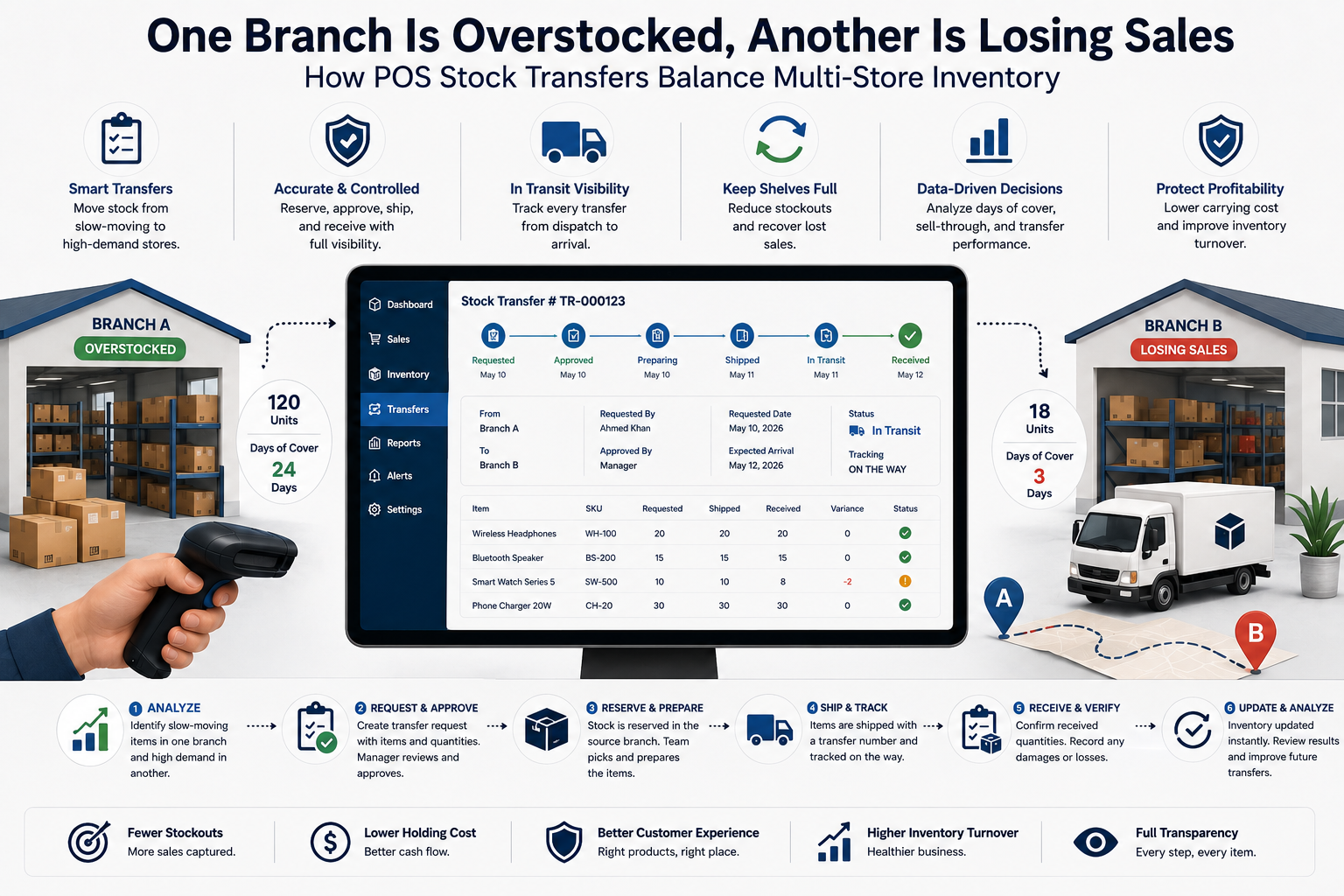
One Branch Is Overstocked, Another Is Losing Sales: How POS Stock Transfers Balance Multi-Store Inventory
Moving stock between branches looks simple, but poor transfer control creates phantom inventory, duplicate availability, missing cartons, delayed receiving, and unreliable reports. Learn how a modern POS should request, ship, receive, reconcile, and analyze inter-branch transfers.
Read article