
The Stockroom Is Holding Your Cash: How POS Systems Improve Purchasing and Cash Flow in 2026
A practical guide to using POS sales, inventory, supplier, and margin data to buy smarter, reduce overstock, prevent stockouts, improve cash flow, and make replenishment decisions with confidence.
The Stockroom Is Holding Your Cash: How POS Systems Improve Purchasing and Cash Flow in 2026
A practical guide to using POS sales, inventory, supplier, and margin data to buy smarter, reduce overstock, prevent stockouts, improve cash flow, and make replenishment decisions with confidence.
The Problem Is Not Always Low Sales—Sometimes It Is Too Much Stock
A store can look busy and still feel short of cash. The reason is often sitting quietly on the shelves: products bought months ago, slow variants ordered in large quantities, seasonal stock that missed its window, or attractive supplier deals that required more inventory than the business could comfortably carry.
Every box in the stockroom is money that cannot pay rent, salaries, marketing, tax, or the next fast-moving order. That does not mean inventory is bad. It means inventory has to earn its place. A modern POS helps the owner see which products convert cash quickly and which ones keep cash trapped.
A Good Reorder Decision Uses More Than Yesterday’s Sales
Yesterday’s sales matter, but they are not enough. A useful reorder decision considers current stock, recent velocity, seasonality, promotions, supplier lead time, minimum order quantity, incoming purchase orders, returns, damaged units, branch demand, and the margin generated by the item.
Imagine two products that each sold ten units this week. One supplier can deliver tomorrow; the other takes three weeks. One product has 40 units on the shelf; the other has four. The sales number is identical, but the purchasing decision is completely different.
Supplier Performance Belongs Inside the Purchasing Decision
A low price is not always a good purchase. A supplier who delivers late, ships incomplete orders, changes prices without warning, or creates frequent quality problems can cost more than a slightly higher-priced but reliable supplier.
POS and purchasing records can show expected versus received quantity, actual lead time, return rate by supplier, cost changes, stockouts caused by delay, and the margin after hidden handling costs. The buyer can then negotiate with evidence instead of memory.
Forecasting Should Guide Buyers, Not Replace Them
Forecasting is most useful when it handles repetitive products and gives buyers more time for judgment. Core items with stable demand can be replenished automatically or presented as purchase-order suggestions. New products, trends, local events, weather-sensitive items, and fashion decisions still need human context.
The buyer should ask why the forecast changed. Was it a promotion, a holiday, a branch opening, a one-time bulk order, or a genuine shift? A system that produces a number without explaining the signal can automate the wrong decision faster.
The Cash-Flow View Changes What You Buy
Purchasing teams often think in units while owners think in money. The bridge is an open-to-buy or cash-aware purchasing view: how much money is already committed to incoming stock, how much cash is expected from sales, which bills are due, and how much inventory the business can safely add.
A high-margin item may still be a poor purchase if it moves too slowly. A lower-margin staple may deserve priority because it turns into cash several times per month. The strongest buying plan balances margin, velocity, stock cover, and payment timing.
A Weekly Purchasing Rhythm That Keeps Growth Under Control
Create a weekly purchasing meeting built around exceptions. Which items will run out before the next delivery? Which items have more than eight or twelve weeks of cover? Which suppliers are late? Which promotions need stock confirmation? Which purchase orders should be reduced, delayed, or cancelled?
Use the POS to create draft decisions, then let a responsible buyer review them. Track what was ordered, why, when it arrived, how quickly it sold, and whether the expected margin was achieved.
Dashierly or any POS should be evaluated by how well it connects sales, stock, suppliers, receiving, returns, branches, expenses, reporting, and permissions. The goal is not to automate purchasing blindly. It is to help the business keep the right products available without turning cash into forgotten boxes.
A simple purchasing report should separate on-hand, available, reserved, in-transit, damaged, and on-order quantities. Mixing them creates false confidence.
Supplier payment terms matter. A higher unit cost with 45-day terms can protect cash better than a cheaper order that must be paid immediately.
Promotions should be approved only after stock, lead time, supplier commitment, margin, and branch allocation are confirmed.
Measure purchasing quality with stockout rate, weeks of cover, aged inventory, inventory turnover, supplier fill rate, lead-time accuracy, markdowns, and cash tied in stock.
Do not automate bad product data. Duplicate SKUs, wrong pack sizes, missing barcodes, and inconsistent units create confident but incorrect purchase orders.
The purpose of forecasting is not to predict perfectly. It is to reduce avoidable surprises and give the buyer time to respond.
A simple purchasing report should separate on-hand, available, reserved, in-transit, damaged, and on-order quantities. Mixing them creates false confidence.
Supplier payment terms matter. A higher unit cost with 45-day terms can protect cash better than a cheaper order that must be paid immediately.
Promotions should be approved only after stock, lead time, supplier commitment, margin, and branch allocation are confirmed.
Measure purchasing quality with stockout rate, weeks of cover, aged inventory, inventory turnover, supplier fill rate, lead-time accuracy, markdowns, and cash tied in stock.
Do not automate bad product data. Duplicate SKUs, wrong pack sizes, missing barcodes, and inconsistent units create confident but incorrect purchase orders.
The purpose of forecasting is not to predict perfectly. It is to reduce avoidable surprises and give the buyer time to respond.
A simple purchasing report should separate on-hand, available, reserved, in-transit, damaged, and on-order quantities. Mixing them creates false confidence.
Supplier payment terms matter. A higher unit cost with 45-day terms can protect cash better than a cheaper order that must be paid immediately.
Promotions should be approved only after stock, lead time, supplier commitment, margin, and branch allocation are confirmed.
Measure purchasing quality with stockout rate, weeks of cover, aged inventory, inventory turnover, supplier fill rate, lead-time accuracy, markdowns, and cash tied in stock.
Keep reading

The Website Says “In Stock,” but the Shelf Is Empty: How POS Systems Prevent Omnichannel Inventory Failures
Online orders, store sales, pickup reservations, returns, and transfers compete for the same units. Learn how a connected POS protects inventory accuracy, prevents overselling, and keeps click-and-collect promises realistic.
Read article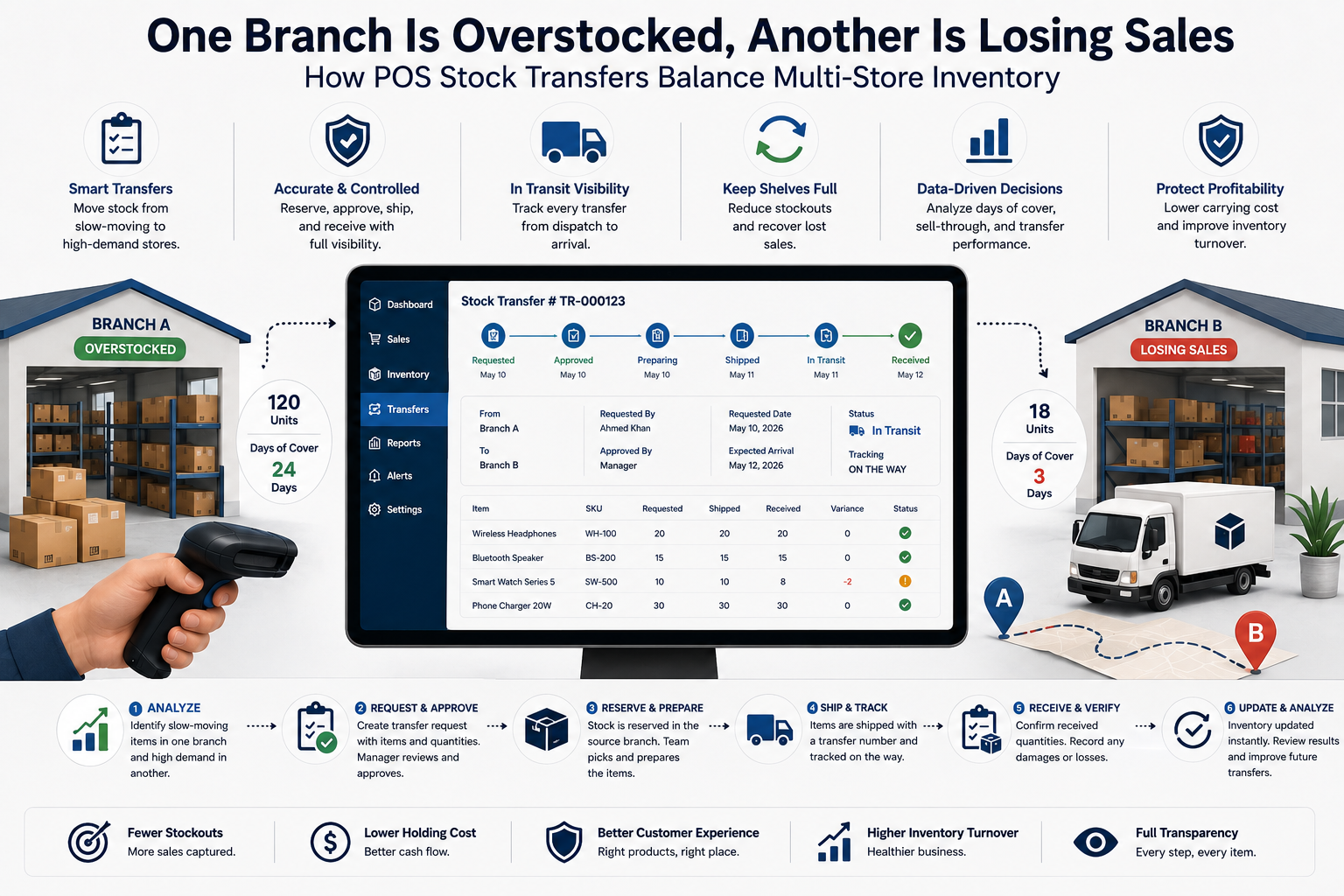
One Branch Is Overstocked, Another Is Losing Sales: How POS Stock Transfers Balance Multi-Store Inventory
Moving stock between branches looks simple, but poor transfer control creates phantom inventory, duplicate availability, missing cartons, delayed receiving, and unreliable reports. Learn how a modern POS should request, ship, receive, reconcile, and analyze inter-branch transfers.
Read article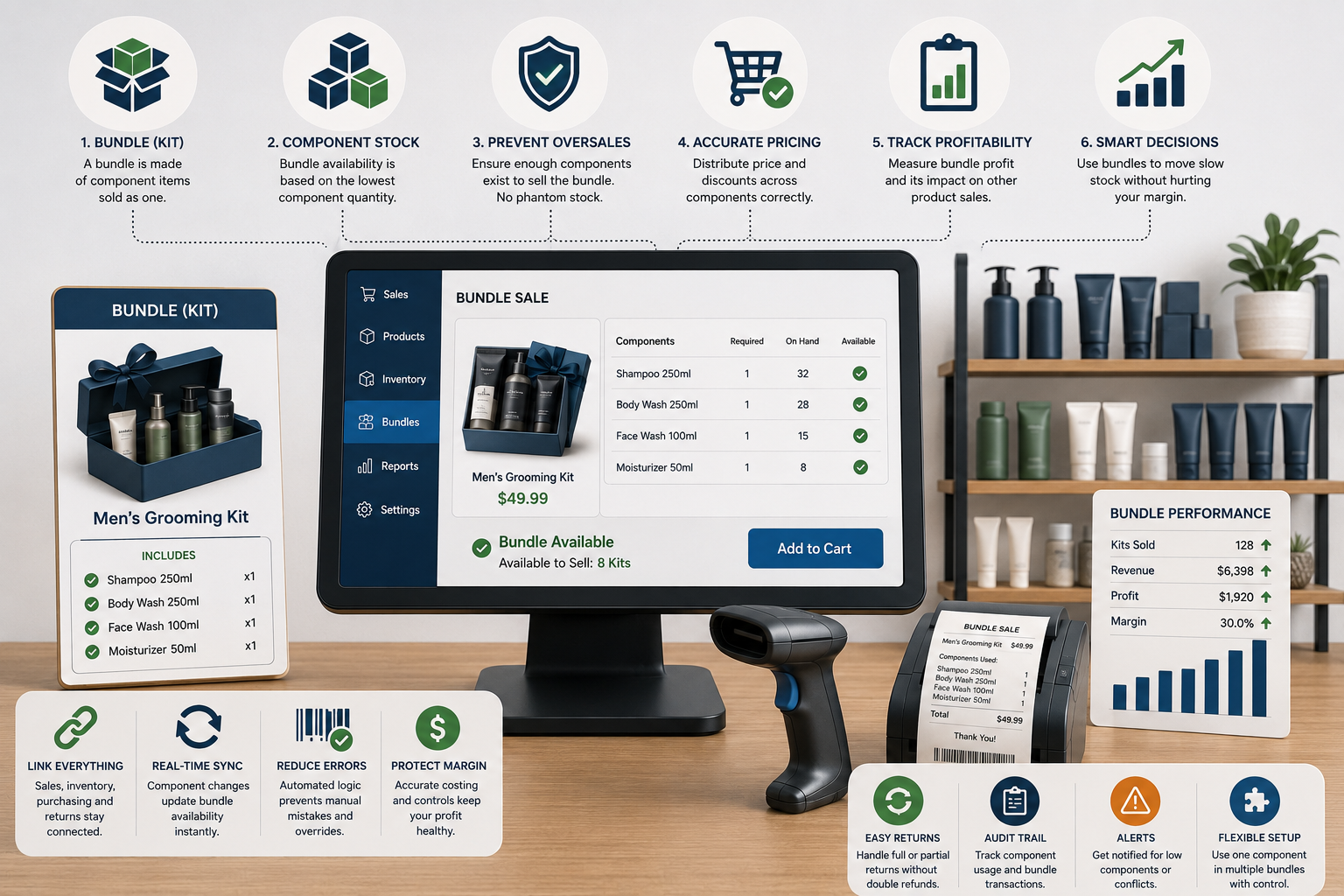
The Bundle Sold Out, but Every Item Is Still on the Shelf: How POS Systems Should Manage Kits, Multipacks, and Component Stock
Bundles can raise basket value, simplify buying, and move slow stock—but poor setup creates phantom availability, overselling, wrong costs, and confusing returns. Learn how POS systems should manage components, pricing, inventory, purchasing, and profitability.
Read article