
Your POS Can Recommend the Next Move—But Should It Make the Decision? A Practical Guide to AI in Retail Operations
AI is moving from dashboards into daily retail decisions: forecasting demand, suggesting reorders, detecting anomalies, predicting churn, and summarizing performance. Learn where AI adds value, where human approval still matters, and how to build reliable controls around an intelligent POS.

Your POS Can Recommend the Next Move—But Should It Make the Decision? A Practical Guide to AI in Retail Operations
AI is moving from dashboards into daily retail decisions: forecasting demand, suggesting reorders, detecting anomalies, predicting churn, and summarizing performance. Learn where AI adds value, where human approval still matters, and how to build reliable controls around an intelligent POS.
AI Is Most Useful When It Reduces Uncertainty
Artificial intelligence inside a point-of-sale platform should not be treated as a decorative chatbot. Its strongest role is to reduce uncertainty around decisions that already exist in retail: how much to buy, which branch needs stock, why margin changed, which transaction deserves review, and what action a manager should take first.
A useful AI feature turns a large amount of operational data into a smaller set of explainable choices. It should show the evidence behind a recommendation, the expected impact, the confidence level, and the assumptions that could make the recommendation wrong.
Consider a real store scenario: Artificial intelligence inside a point-of-sale platform should not be treated as a decorative chatbot. Its strongest role is to reduce uncertainty around decisions that already exist in retail: how much to buy, which branch needs stock, why margin changed, which transaction deserves review, and what action a manager should take first. The system should allow managers to add known future events, compare several scenarios, and see how the forecast changes. It should never hide uncertainty behind one precise-looking number. An anomaly is not proof of fraud or failure. It is a signal that needs context. The POS should show why the activity was flagged, what normal behaviour looks like, and which related transactions or users should be reviewed. The recommendation should be reviewed against cost, customer impact, reversibility, confidence, and the consequences of a wrong decision.
Consider a real store scenario: AI depends on product catalogues, clean barcodes, accurate costs, complete receiving records, consistent branch mapping, customer consent, and reliable transaction history. Poor data produces recommendations that sound intelligent but reflect incorrect reality. Use thresholds, role-based approval, maximum values, test environments, rollback, temporary automation, and clear logs. The safest design lets the system prepare the action while a responsible person confirms it. A useful AI feature turns a large amount of operational data into a smaller set of explainable choices. It should show the evidence behind a recommendation, the expected impact, the confidence level, and the assumptions that could make the recommendation wrong. The recommendation should be reviewed against cost, customer impact, reversibility, confidence, and the consequences of a wrong decision.
Forecasts Need Context, Not Blind Trust
Demand forecasting can combine recent sales, seasonality, promotions, stockouts, holidays, branch behaviour, supplier lead time, and external events. Yet the forecast still needs human context. A road closure, competitor opening, school event, or local campaign may not be visible in historical data.
The system should allow managers to add known future events, compare several scenarios, and see how the forecast changes. It should never hide uncertainty behind one precise-looking number.
Consider a real store scenario: The system should allow managers to add known future events, compare several scenarios, and see how the forecast changes. It should never hide uncertainty behind one precise-looking number. Not every AI recommendation should execute automatically. Low-risk actions such as drafting a purchase order or creating a task can be automated more freely. High-risk actions such as changing prices, issuing refunds, modifying permissions, or placing a large supplier order need approval. Demand forecasting can combine recent sales, seasonality, promotions, stockouts, holidays, branch behaviour, supplier lead time, and external events. Yet the forecast still needs human context. A road closure, competitor opening, school event, or local campaign may not be visible in historical data. The recommendation should be reviewed against cost, customer impact, reversibility, confidence, and the consequences of a wrong decision.
Consider a real store scenario: Dashierly or any intelligent POS should use AI as a disciplined assistant: it observes, explains, recommends, and learns from outcomes. The business should remain able to understand, approve, challenge, and reverse important decisions. Measure the effect on stockouts, excess inventory, purchase-order accuracy, margin, manager time, false alerts, customer retention, and speed of investigation. A feature that generates many insights but changes no decision is only a more expensive report. Measure the effect on stockouts, excess inventory, purchase-order accuracy, margin, manager time, false alerts, customer retention, and speed of investigation. A feature that generates many insights but changes no decision is only a more expensive report. The recommendation should be reviewed against cost, customer impact, reversibility, confidence, and the consequences of a wrong decision.
Anomaly Detection Should Start an Investigation
Anomaly detection can find unusual refunds, sudden cost changes, repeated price overrides, negative stock, abnormal discounts, or sales patterns that differ from a branch’s normal behaviour. This is valuable because managers cannot manually review every transaction.
An anomaly is not proof of fraud or failure. It is a signal that needs context. The POS should show why the activity was flagged, what normal behaviour looks like, and which related transactions or users should be reviewed.
Consider a real store scenario: A useful AI feature turns a large amount of operational data into a smaller set of explainable choices. It should show the evidence behind a recommendation, the expected impact, the confidence level, and the assumptions that could make the recommendation wrong. AI depends on product catalogues, clean barcodes, accurate costs, complete receiving records, consistent branch mapping, customer consent, and reliable transaction history. Poor data produces recommendations that sound intelligent but reflect incorrect reality. Artificial intelligence inside a point-of-sale platform should not be treated as a decorative chatbot. Its strongest role is to reduce uncertainty around decisions that already exist in retail: how much to buy, which branch needs stock, why margin changed, which transaction deserves review, and what action a manager should take first. The recommendation should be reviewed against cost, customer impact, reversibility, confidence, and the consequences of a wrong decision.
Consider a real store scenario: Use thresholds, role-based approval, maximum values, test environments, rollback, temporary automation, and clear logs. The safest design lets the system prepare the action while a responsible person confirms it. Demand forecasting can combine recent sales, seasonality, promotions, stockouts, holidays, branch behaviour, supplier lead time, and external events. Yet the forecast still needs human context. A road closure, competitor opening, school event, or local campaign may not be visible in historical data. Not every AI recommendation should execute automatically. Low-risk actions such as drafting a purchase order or creating a task can be automated more freely. High-risk actions such as changing prices, issuing refunds, modifying permissions, or placing a large supplier order need approval. The recommendation should be reviewed against cost, customer impact, reversibility, confidence, and the consequences of a wrong decision.
Consider a real store scenario: Before enabling an AI workflow, measure missing fields, duplicate products, unexplained stock adjustments, delayed synchronization, and inconsistent units of measure. Data cleanup may create more value than a new model. Artificial intelligence inside a point-of-sale platform should not be treated as a decorative chatbot. Its strongest role is to reduce uncertainty around decisions that already exist in retail: how much to buy, which branch needs stock, why margin changed, which transaction deserves review, and what action a manager should take first. AI depends on product catalogues, clean barcodes, accurate costs, complete receiving records, consistent branch mapping, customer consent, and reliable transaction history. Poor data produces recommendations that sound intelligent but reflect incorrect reality. The recommendation should be reviewed against cost, customer impact, reversibility, confidence, and the consequences of a wrong decision.
Automation Needs Approval Levels and Safe Limits
Not every AI recommendation should execute automatically. Low-risk actions such as drafting a purchase order or creating a task can be automated more freely. High-risk actions such as changing prices, issuing refunds, modifying permissions, or placing a large supplier order need approval.
Use thresholds, role-based approval, maximum values, test environments, rollback, temporary automation, and clear logs. The safest design lets the system prepare the action while a responsible person confirms it.
Consider a real store scenario: Anomaly detection can find unusual refunds, sudden cost changes, repeated price overrides, negative stock, abnormal discounts, or sales patterns that differ from a branch’s normal behaviour. This is valuable because managers cannot manually review every transaction. Dashierly or any intelligent POS should use AI as a disciplined assistant: it observes, explains, recommends, and learns from outcomes. The business should remain able to understand, approve, challenge, and reverse important decisions. Before enabling an AI workflow, measure missing fields, duplicate products, unexplained stock adjustments, delayed synchronization, and inconsistent units of measure. Data cleanup may create more value than a new model. The recommendation should be reviewed against cost, customer impact, reversibility, confidence, and the consequences of a wrong decision.
Data Quality Determines the Quality of Every Recommendation
AI depends on product catalogues, clean barcodes, accurate costs, complete receiving records, consistent branch mapping, customer consent, and reliable transaction history. Poor data produces recommendations that sound intelligent but reflect incorrect reality.
Before enabling an AI workflow, measure missing fields, duplicate products, unexplained stock adjustments, delayed synchronization, and inconsistent units of measure. Data cleanup may create more value than a new model.
Consider a real store scenario: Demand forecasting can combine recent sales, seasonality, promotions, stockouts, holidays, branch behaviour, supplier lead time, and external events. Yet the forecast still needs human context. A road closure, competitor opening, school event, or local campaign may not be visible in historical data. A useful AI feature turns a large amount of operational data into a smaller set of explainable choices. It should show the evidence behind a recommendation, the expected impact, the confidence level, and the assumptions that could make the recommendation wrong. Use thresholds, role-based approval, maximum values, test environments, rollback, temporary automation, and clear logs. The safest design lets the system prepare the action while a responsible person confirms it. The recommendation should be reviewed against cost, customer impact, reversibility, confidence, and the consequences of a wrong decision.
Consider a real store scenario: Not every AI recommendation should execute automatically. Low-risk actions such as drafting a purchase order or creating a task can be automated more freely. High-risk actions such as changing prices, issuing refunds, modifying permissions, or placing a large supplier order need approval. Before enabling an AI workflow, measure missing fields, duplicate products, unexplained stock adjustments, delayed synchronization, and inconsistent units of measure. Data cleanup may create more value than a new model. Dashierly or any intelligent POS should use AI as a disciplined assistant: it observes, explains, recommends, and learns from outcomes. The business should remain able to understand, approve, challenge, and reverse important decisions. The recommendation should be reviewed against cost, customer impact, reversibility, confidence, and the consequences of a wrong decision.
Consider a real store scenario: Measure the effect on stockouts, excess inventory, purchase-order accuracy, margin, manager time, false alerts, customer retention, and speed of investigation. A feature that generates many insights but changes no decision is only a more expensive report. An anomaly is not proof of fraud or failure. It is a signal that needs context. The POS should show why the activity was flagged, what normal behaviour looks like, and which related transactions or users should be reviewed. The system should allow managers to add known future events, compare several scenarios, and see how the forecast changes. It should never hide uncertainty behind one precise-looking number. The recommendation should be reviewed against cost, customer impact, reversibility, confidence, and the consequences of a wrong decision.
Measure Business Outcomes, Not the Number of AI Features
Measure the effect on stockouts, excess inventory, purchase-order accuracy, margin, manager time, false alerts, customer retention, and speed of investigation. A feature that generates many insights but changes no decision is only a more expensive report.
Dashierly or any intelligent POS should use AI as a disciplined assistant: it observes, explains, recommends, and learns from outcomes. The business should remain able to understand, approve, challenge, and reverse important decisions.
Consider a real store scenario: An anomaly is not proof of fraud or failure. It is a signal that needs context. The POS should show why the activity was flagged, what normal behaviour looks like, and which related transactions or users should be reviewed. Anomaly detection can find unusual refunds, sudden cost changes, repeated price overrides, negative stock, abnormal discounts, or sales patterns that differ from a branch’s normal behaviour. This is valuable because managers cannot manually review every transaction. Anomaly detection can find unusual refunds, sudden cost changes, repeated price overrides, negative stock, abnormal discounts, or sales patterns that differ from a branch’s normal behaviour. This is valuable because managers cannot manually review every transaction. The recommendation should be reviewed against cost, customer impact, reversibility, confidence, and the consequences of a wrong decision.
Keep reading
The Register Is Short—But Where Did the Money Go? A Practical POS Guide to Cash Drawers and Payment Reconciliation
A cash difference at closing does not automatically mean theft. Learn how POS register sessions, floats, paid-in and paid-out movements, refunds, tips, card settlements, and clear accountability help retailers reconcile every payment method.
Read article
The Gift Card Was Sold Months Ago—Why Is It Still Money You Owe? How POS Systems Manage Stored Value
Gift cards and store credit bring cash in early, but they also create balances, redemption obligations, fraud risks, expiry questions, split payments, refunds, and accounting work. Learn how a modern POS should manage stored value from issue to final redemption.
Read article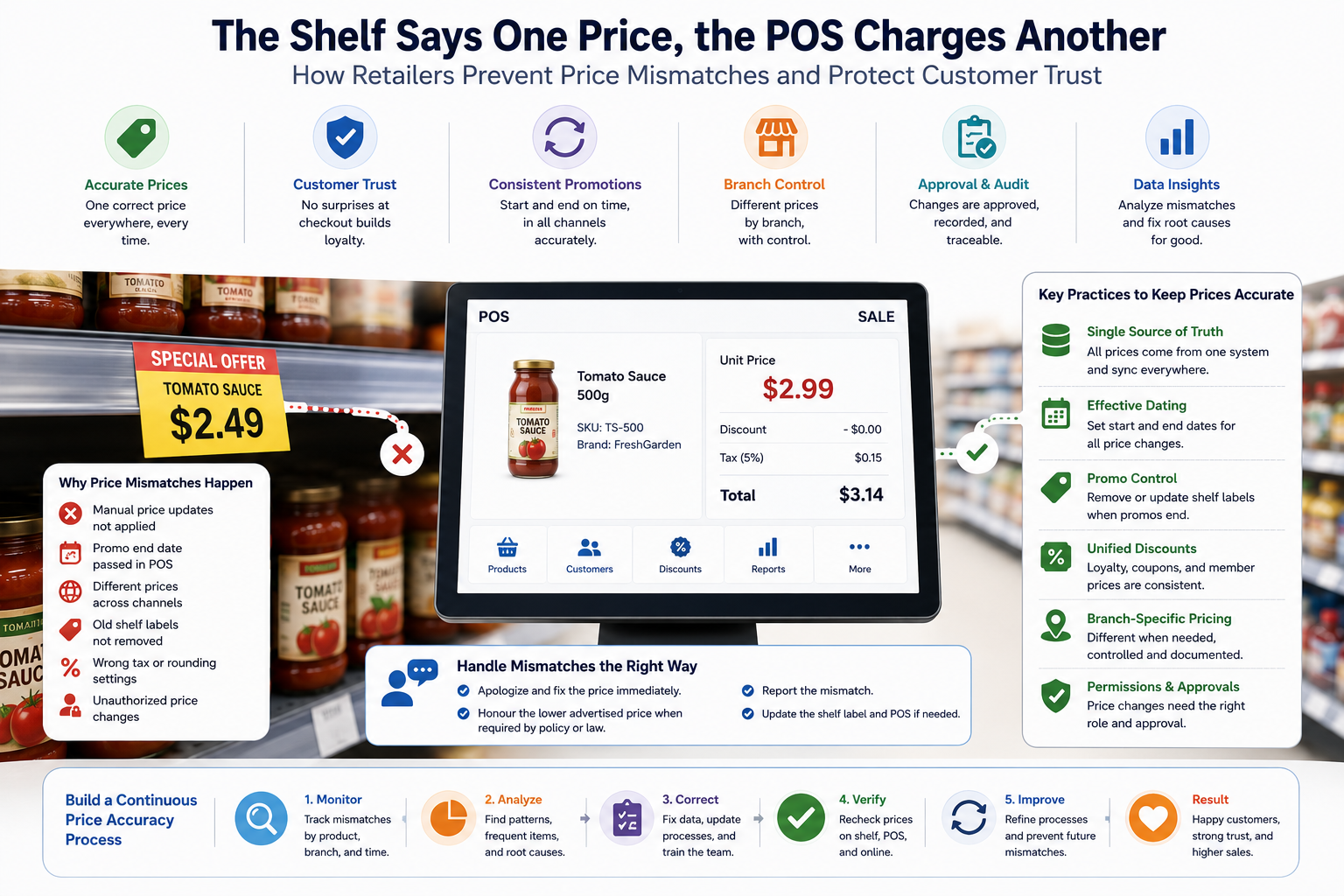
The Shelf Says One Price, the POS Charges Another: How Retailers Prevent Price Mismatches and Protect Customer Trust
Price mismatches are more than an awkward checkout moment. They create refunds, complaints, margin leakage, regulatory risk, and lost trust. Learn how a modern POS should synchronize price lists, shelf labels, promotions, branches, taxes, and approvals.
Read article