
The Gift Card Was Sold Months Ago—Why Is It Still Money You Owe? How POS Systems Manage Stored Value
Gift cards and store credit bring cash in early, but they also create balances, redemption obligations, fraud risks, expiry questions, split payments, refunds, and accounting work. Learn how a modern POS should manage stored value from issue to final redemption.

The Gift Card Was Sold Months Ago—Why Is It Still Money You Owe? How POS Systems Manage Stored Value
Gift cards and store credit bring cash in early, but they also create balances, redemption obligations, fraud risks, expiry questions, split payments, refunds, and accounting work. Learn how a modern POS should manage stored value from issue to final redemption.
Selling Value Is Not the Same as Earning Revenue
When a retailer sells a $100 gift card, cash enters the business immediately, but the customer has not yet received merchandise. The retailer has promised to provide goods or services later. Operationally, that unused balance behaves more like an obligation than a completed product sale.
The POS should separate gift-card issuance from redemption. Otherwise daily sales reports can count the same economic value twice: once when the card is loaded and again when it is used to buy products.
For example, When a retailer sells a $100 gift card, cash enters the business immediately, but the customer has not yet received merchandise. The retailer has promised to provide goods or services later. Operationally, that unused balance behaves more like an obligation than a completed product sale. Define whether each instrument can be transferred, combined, reloaded, refunded, used online, used across branches, converted to cash, or applied to taxes, shipping, subscriptions, and restricted products. The scenario should be tested with a partial redemption, a split payment, a cancelled sale, a deactivated card, a refund, and a replacement balance before launch.
Gift Cards and Store Credit Need Separate Identities
A gift card is usually transferable stored value identified by a number, barcode, QR code, or digital token. Store credit is commonly issued to a specific customer after a return, service recovery, or account adjustment. They may look similar at checkout but require different rules.
Define whether each instrument can be transferred, combined, reloaded, refunded, used online, used across branches, converted to cash, or applied to taxes, shipping, subscriptions, and restricted products.
For example, Define whether each instrument can be transferred, combined, reloaded, refunded, used online, used across branches, converted to cash, or applied to taxes, shipping, subscriptions, and restricted products. A customer may pay part of an order with a gift card and the remainder by cash or bank card. The POS must allocate each tender correctly, preserve the remaining gift-card balance, and refund no more than was originally paid through each method. The scenario should be tested with a partial redemption, a split payment, a cancelled sale, a deactivated card, a refund, and a replacement balance before launch.
Every Balance Movement Must Be Traceable
Every load, redemption, refund, cancellation, expiry, reactivation, manual adjustment, transfer, and balance inquiry should create an event with time, branch, device, user, customer where relevant, previous balance, change, new balance, reason, and related transaction.
The system should never allow staff to edit a balance without leaving a durable record. Deactivated or replaced cards should retain history so finance and customer service can explain what happened.
For example, The POS should separate gift-card issuance from redemption. Otherwise daily sales reports can count the same economic value twice: once when the card is loaded and again when it is used to buy products. Gift-card fraud can involve stolen payment cards used to purchase stored value, employee-created cards, unauthorized balance checks, code theft, card tampering, social engineering, refund abuse, and rapid redemption before a transaction can be reviewed. The scenario should be tested with a partial redemption, a split payment, a cancelled sale, a deactivated card, a refund, and a replacement balance before launch.
Split Payments and Refunds Need Exact Tender Logic
A customer may pay part of an order with a gift card and the remainder by cash or bank card. The POS must allocate each tender correctly, preserve the remaining gift-card balance, and refund no more than was originally paid through each method.
If a payment used a gift card that has since been deactivated, the business needs a controlled replacement process. Refunds to new store credit or a new gift card should link back to the original sale and approval.
For example, Every load, redemption, refund, cancellation, expiry, reactivation, manual adjustment, transfer, and balance inquiry should create an event with time, branch, device, user, customer where relevant, previous balance, change, new balance, reason, and related transaction. Dashierly or any POS should make gift cards easy for customers but precise for operations. The strongest system treats every balance as controlled value from creation to redemption, protects the audit trail, and prevents promotional convenience from becoming unexplained financial risk. The scenario should be tested with a partial redemption, a split payment, a cancelled sale, a deactivated card, a refund, and a replacement balance before launch.
Fraud Often Targets Issuance, Balance Checks, and Refunds
Gift-card fraud can involve stolen payment cards used to purchase stored value, employee-created cards, unauthorized balance checks, code theft, card tampering, social engineering, refund abuse, and rapid redemption before a transaction can be reviewed.
Use activation only after successful payment, role-based issuance limits, approval for manual loads, velocity limits, secure code display, masked balances, failed-attempt monitoring, device and location signals, and exception reports for unusual creation or redemption patterns.
For example, A gift card is usually transferable stored value identified by a number, barcode, QR code, or digital token. Store credit is commonly issued to a specific customer after a return, service recovery, or account adjustment. They may look similar at checkout but require different rules. The POS should separate gift-card issuance from redemption. Otherwise daily sales reports can count the same economic value twice: once when the card is loaded and again when it is used to buy products. The scenario should be tested with a partial redemption, a split payment, a cancelled sale, a deactivated card, a refund, and a replacement balance before launch.
Reconcile Outstanding Value Like Real Money
Reconcile cards issued, value loaded, value redeemed, refunds, adjustments, expiries, replacements, outstanding balances, and channel or branch differences. The outstanding total should match the stored-value liability or operational control account used by finance.
Dashierly or any POS should make gift cards easy for customers but precise for operations. The strongest system treats every balance as controlled value from creation to redemption, protects the audit trail, and prevents promotional convenience from becoming unexplained financial risk.
For example, The system should never allow staff to edit a balance without leaving a durable record. Deactivated or replaced cards should retain history so finance and customer service can explain what happened. Every load, redemption, refund, cancellation, expiry, reactivation, manual adjustment, transfer, and balance inquiry should create an event with time, branch, device, user, customer where relevant, previous balance, change, new balance, reason, and related transaction. The scenario should be tested with a partial redemption, a split payment, a cancelled sale, a deactivated card, a refund, and a replacement balance before launch.
Keep reading

Your Warehouse Is Full, but the Best Sellers Are Missing: How POS Data Fixes Replenishment and Dead Stock
A full warehouse does not mean healthy inventory. Learn how POS sales velocity, lead time, seasonality, reorder points, supplier performance, transfers, and dead-stock analysis help retailers buy the right products at the right time.
Read article
The Register Is Short—But Where Did the Money Go? A Practical POS Guide to Cash Drawers and Payment Reconciliation
A cash difference at closing does not automatically mean theft. Learn how POS register sessions, floats, paid-in and paid-out movements, refunds, tips, card settlements, and clear accountability help retailers reconcile every payment method.
Read article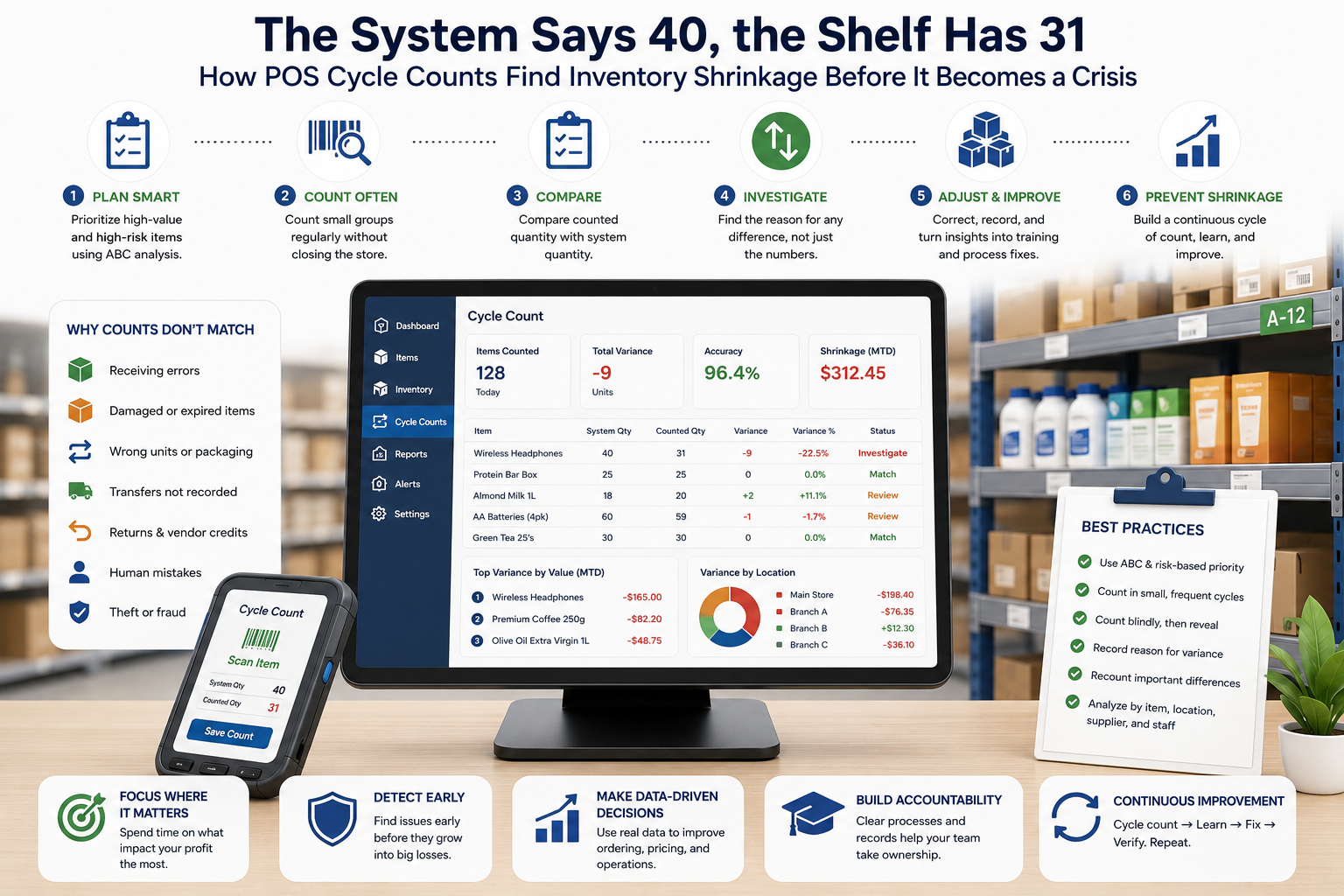
The System Says 40, the Shelf Has 31: How POS Cycle Counts Find Inventory Shrinkage Before It Becomes a Crisis
Inventory discrepancies rarely appear all at once. They build through receiving mistakes, unrecorded damage, wrong units, theft, transfers, returns, and stock adjustments. Learn how POS cycle counts, variance analysis, and root-cause workflows restore accuracy without closing the entire store.
Read article