
The Website Says “In Stock,” but the Shelf Is Empty: How POS Systems Prevent Omnichannel Inventory Failures
Online orders, store sales, pickup reservations, returns, and transfers compete for the same units. Learn how a connected POS protects inventory accuracy, prevents overselling, and keeps click-and-collect promises realistic.

The Website Says “In Stock,” but the Shelf Is Empty: How POS Systems Prevent Omnichannel Inventory Failures
Online orders, store sales, pickup reservations, returns, and transfers compete for the same units. Learn how a connected POS protects inventory accuracy, prevents overselling, and keeps click-and-collect promises realistic.
One Unit Can Be Promised to Several Customers
A customer buys the final unit online at 10:01. At 10:02, a cashier scans the same unit for a walk-in customer. At 10:03, another branch requests a transfer because its dashboard still shows one available. Each action is reasonable on its own, but the retailer has now promised one product three times.
Omnichannel inventory fails when sales channels update separate stock records, when reservations arrive late, or when staff treat an online order as information rather than a claim on physical stock.
For example, A customer buys the final unit online at 10:01. At 10:02, a cashier scans the same unit for a walk-in customer. At 10:03, another branch requests a transfer because its dashboard still shows one available. Each action is reasonable on its own, but the retailer has now promised one product three times. Retailers need a deliberate formula for available-to-promise inventory. Showing every physical unit online can increase conversion for a few minutes and create cancellations, refunds, support calls, and lost trust later. The operational rule should be tested with the final unit, a cancellation, a delayed sync, a return, and two simultaneous orders before launch.
Available Stock Is Not the Same as On-Hand Stock
On-hand stock is what the system believes physically exists. Available stock should subtract units already reserved for online orders, pickup, open carts where policy requires, damaged goods, transfers, safety buffers, and other commitments.
Retailers need a deliberate formula for available-to-promise inventory. Showing every physical unit online can increase conversion for a few minutes and create cancellations, refunds, support calls, and lost trust later.
For example, Retailers need a deliberate formula for available-to-promise inventory. Showing every physical unit online can increase conversion for a few minutes and create cancellations, refunds, support calls, and lost trust later. Cancelled orders should release reserved stock only when the item is genuinely available again. A return should not automatically become sellable until condition and location are confirmed. Failed pickup orders need an expiry rule and a documented return-to-stock step. The operational rule should be tested with the final unit, a cancellation, a delayed sync, a return, and two simultaneous orders before launch.
Pickup Orders Need a Store Workflow, Not Just a Website Button
A pickup order is not complete when payment succeeds. The branch must receive the task, locate the item, confirm its condition, pick it, mark it unavailable, place it in a controlled holding area, notify the customer, verify collection, and close the order.
Set realistic preparation times and cut-offs. If the last unit cannot be found, staff need a defined alternative: source another branch, offer substitution, ship later, cancel quickly, or contact the customer before they travel.
For example, Omnichannel inventory fails when sales channels update separate stock records, when reservations arrive late, or when staff treat an online order as information rather than a claim on physical stock. Real-time synchronization is the goal, but systems also need to survive delayed messages, duplicate events, network outages, and conflicting updates. Every inventory movement should carry a unique reference, location, timestamp, source channel, and status. The operational rule should be tested with the final unit, a cancellation, a delayed sync, a return, and two simultaneous orders before launch.
Returns and Cancellations Must Release Stock Correctly
Cancelled orders should release reserved stock only when the item is genuinely available again. A return should not automatically become sellable until condition and location are confirmed. Failed pickup orders need an expiry rule and a documented return-to-stock step.
Incorrect release creates phantom inventory. The website may show stock while the item is still in a pickup cage, return inspection area, delivery vehicle, or another branch.
For example, A pickup order is not complete when payment succeeds. The branch must receive the task, locate the item, confirm its condition, pick it, mark it unavailable, place it in a controlled holding area, notify the customer, verify collection, and close the order. Dashierly or any POS should help the business sell anywhere without making promises it cannot keep. Omnichannel success is not merely offering more channels; it is coordinating every channel around the same physical units. The operational rule should be tested with the final unit, a cancellation, a delayed sync, a return, and two simultaneous orders before launch.
Inventory Synchronization Needs Rules for Failure and Delay
Real-time synchronization is the goal, but systems also need to survive delayed messages, duplicate events, network outages, and conflicting updates. Every inventory movement should carry a unique reference, location, timestamp, source channel, and status.
Use idempotent updates, reservation expiry, retry queues, conflict rules, visible pending states, and reconciliation reports. Staff should know when the number is confirmed, estimated, delayed, or under review.
For example, On-hand stock is what the system believes physically exists. Available stock should subtract units already reserved for online orders, pickup, open carts where policy requires, damaged goods, transfers, safety buffers, and other commitments. Omnichannel inventory fails when sales channels update separate stock records, when reservations arrive late, or when staff treat an online order as information rather than a claim on physical stock. The operational rule should be tested with the final unit, a cancellation, a delayed sync, a return, and two simultaneous orders before launch.
Build One Stock Truth Across Every Sales Channel
Create one product catalogue, one location structure, and one inventory ledger that receives store sales, online orders, reservations, transfers, receipts, returns, cancellations, and adjustments. Channel-specific interfaces can differ, but stock logic should not.
Dashierly or any POS should help the business sell anywhere without making promises it cannot keep. Omnichannel success is not merely offering more channels; it is coordinating every channel around the same physical units.
For example, Set realistic preparation times and cut-offs. If the last unit cannot be found, staff need a defined alternative: source another branch, offer substitution, ship later, cancel quickly, or contact the customer before they travel. A pickup order is not complete when payment succeeds. The branch must receive the task, locate the item, confirm its condition, pick it, mark it unavailable, place it in a controlled holding area, notify the customer, verify collection, and close the order. The operational rule should be tested with the final unit, a cancellation, a delayed sync, a return, and two simultaneous orders before launch.
Keep reading
The Customer Paid a Deposit, but the Sale Is Not Finished: How POS Systems Should Manage Preorders, Layaway, and Partial Payments
Deposits, preorders, layaway, special orders, and partial payments can secure demand and improve cash flow—but only when inventory, customer balances, due dates, refunds, and accounting stay connected. Learn how a modern POS should manage the entire order lifecycle.
Read article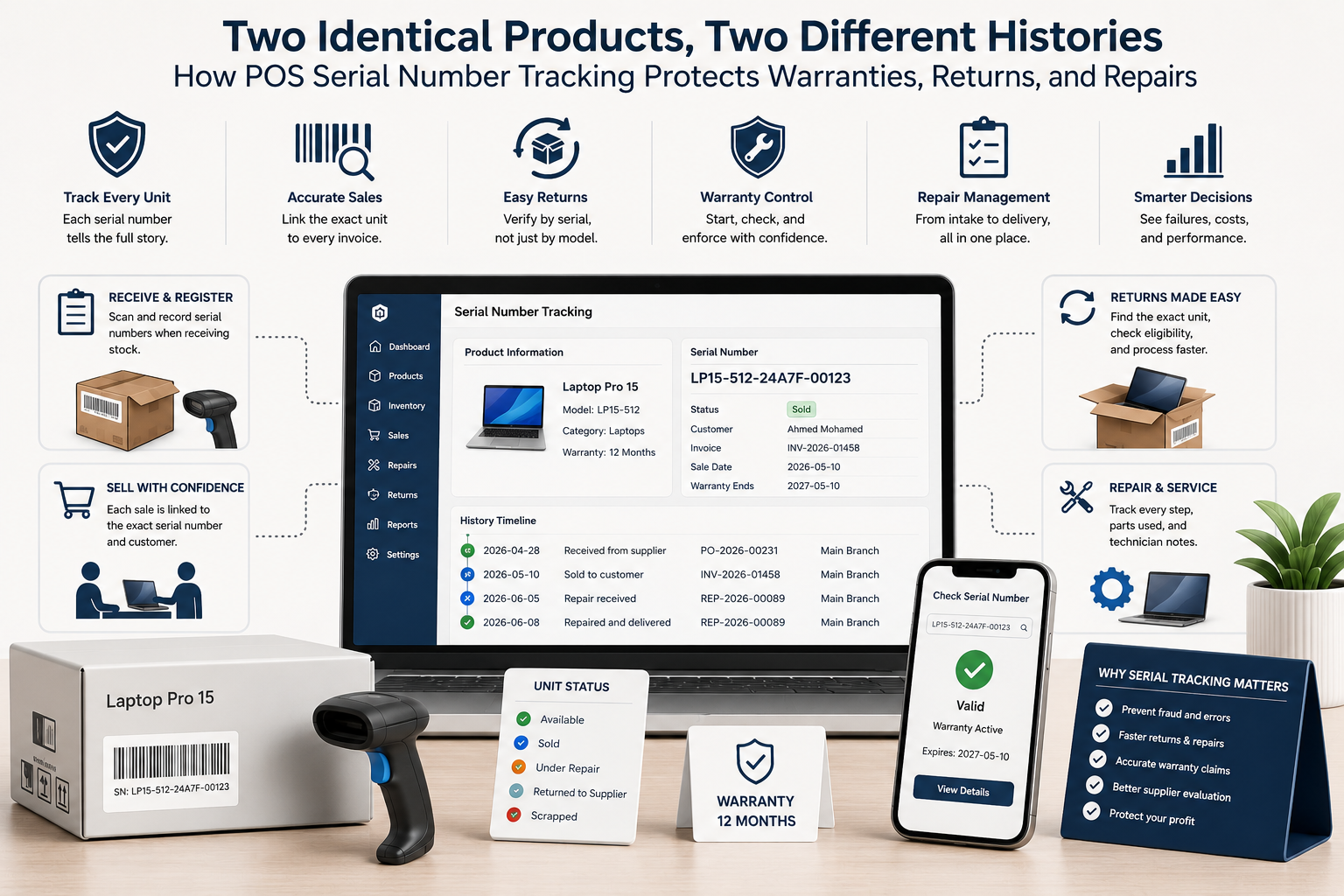
Two Identical Products, Two Different Histories: How POS Serial Number Tracking Protects Warranties, Returns, and Repairs
Quantity tracking tells you how many units exist. Serial tracking tells you exactly which unit was received, sold, returned, repaired, replaced, or still covered by warranty. Learn how a modern POS should manage serialized inventory from supplier receipt to after-sales service.
Read article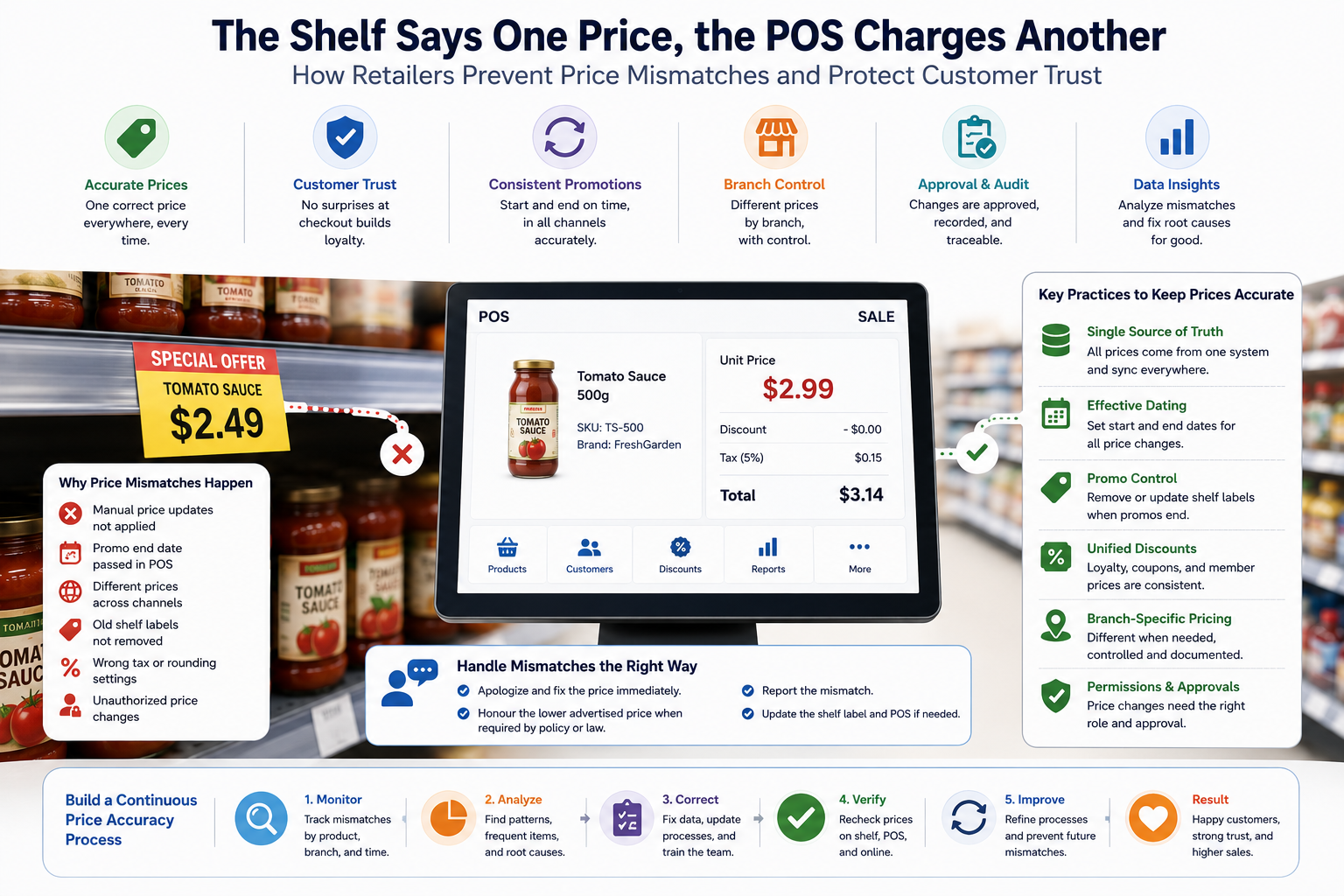
The Shelf Says One Price, the POS Charges Another: How Retailers Prevent Price Mismatches and Protect Customer Trust
Price mismatches are more than an awkward checkout moment. They create refunds, complaints, margin leakage, regulatory risk, and lost trust. Learn how a modern POS should synchronize price lists, shelf labels, promotions, branches, taxes, and approvals.
Read article