
The Discount Worked—But Did the Store Make Money? How POS Promotion Rules Protect Retail Margin
Promotions can increase traffic while quietly damaging margin through discount stacking, wrong eligibility, cashier overrides, returns, and weak reporting. Learn how a modern POS should control offers from setup to post-campaign analysis.
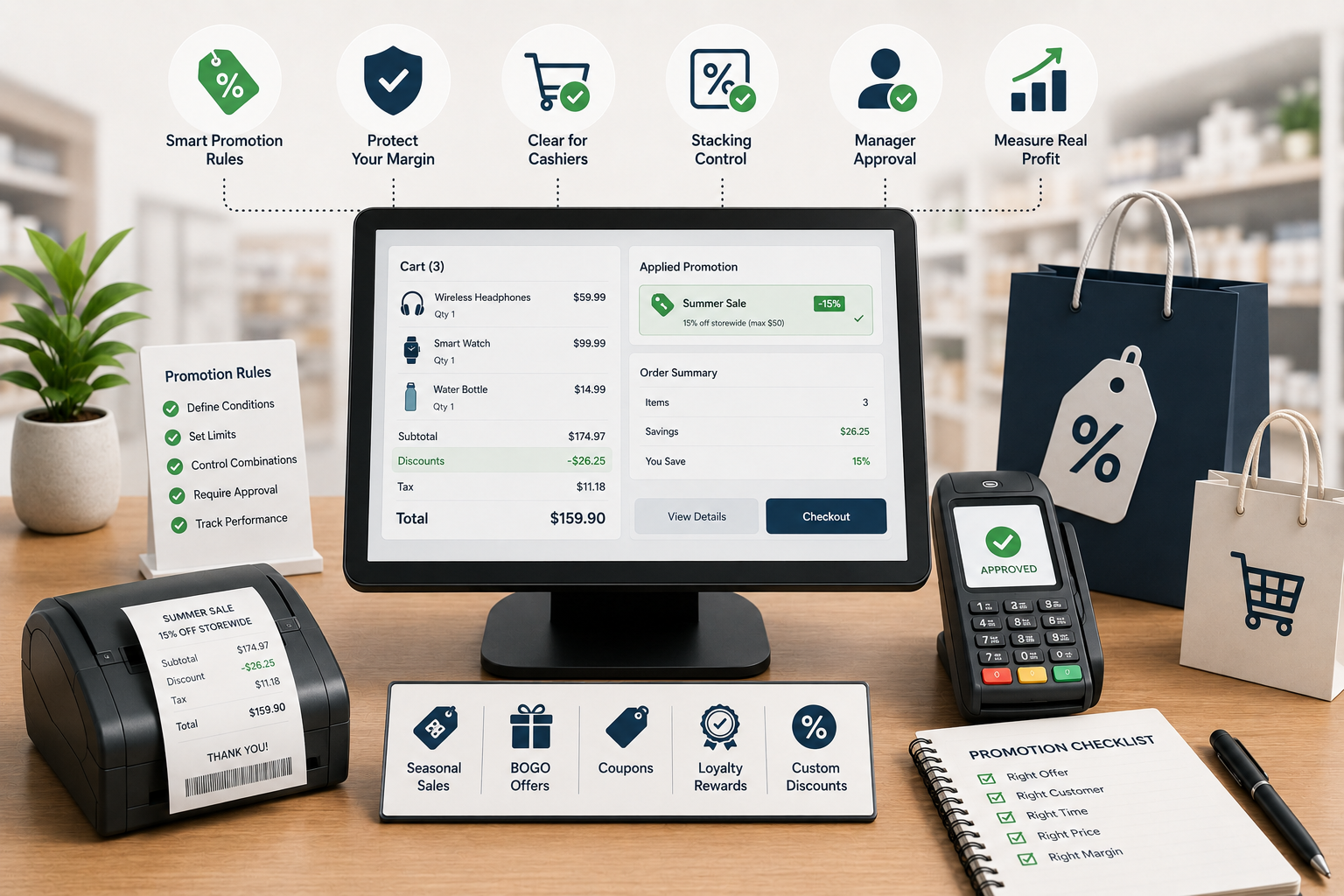
The Discount Worked—But Did the Store Make Money? How POS Promotion Rules Protect Retail Margin
Promotions can increase traffic while quietly damaging margin through discount stacking, wrong eligibility, cashier overrides, returns, and weak reporting. Learn how a modern POS should control offers from setup to post-campaign analysis.
A Promotion Is a Pricing Rule, Not a Poster
A promotion begins as a commercial idea—move a slow category, raise basket size, attract first-time shoppers, or reward loyal customers. It becomes operational only when the POS can translate that idea into exact conditions, calculations, dates, products, customers, locations, and limits.
“Twenty percent off selected items” is incomplete. Which items? Before or after another discount? Does it apply to already reduced products? Is tax calculated before or after the reduction? Can staff add a manual discount on top? What happens if part of the basket is returned?
For example, A promotion begins as a commercial idea—move a slow category, raise basket size, attract first-time shoppers, or reward loyal customers. It becomes operational only when the POS can translate that idea into exact conditions, calculations, dates, products, customers, locations, and limits. The POS needs combination rules: exclusive, combinable, best offer only, maximum total discount, product-level before order-level, or manager approval above a threshold. Overlapping promotions should be visible before launch, not discovered after closing reports. The rule should be tested with an eligible basket, an ineligible basket, overlapping offers, a partial return, and a manual override before launch.
Discount Stacking Can Destroy the Original Offer
Discount stacking happens when several offers affect the same item or order. A product may receive a sale price, automatic promotion, coupon, loyalty reward, employee discount, and manual override. Each discount may look valid separately while the final margin becomes unacceptable.
The POS needs combination rules: exclusive, combinable, best offer only, maximum total discount, product-level before order-level, or manager approval above a threshold. Overlapping promotions should be visible before launch, not discovered after closing reports.
For example, The POS needs combination rules: exclusive, combinable, best offer only, maximum total discount, product-level before order-level, or manager approval above a threshold. Overlapping promotions should be visible before launch, not discovered after closing reports. When a customer returns one item from a bundle, buy-one-get-one offer, or threshold discount, the refund cannot simply use the item’s normal price. The system must reconstruct the actual value allocated to each line. The rule should be tested with an eligible basket, an ineligible basket, overlapping offers, a partial return, and a manual override before launch.
Eligibility Must Be Clear at Checkout
Eligibility should be calculated consistently from product, category, quantity, customer group, location, date, time, payment method, minimum spend, and previous redemptions. The cashier should see why an offer applied or why it did not.
Ambiguous rules create queues and arbitrary decisions. Staff then apply a manual discount to satisfy the customer, which hides the original configuration problem and makes campaign reporting unreliable.
For example, “Twenty percent off selected items” is incomplete. Which items? Before or after another discount? Does it apply to already reduced products? Is tax calculated before or after the reduction? Can staff add a manual discount on top? What happens if part of the basket is returned? Manual discounts are necessary for damaged packaging, service recovery, price matching, manager discretion, or local competition. They become dangerous when every cashier can enter any percentage without a reason or limit. The rule should be tested with an eligible basket, an ineligible basket, overlapping offers, a partial return, and a manual override before launch.
Returns Must Reverse the Real Promotion
When a customer returns one item from a bundle, buy-one-get-one offer, or threshold discount, the refund cannot simply use the item’s normal price. The system must reconstruct the actual value allocated to each line.
Partial returns should preserve the economics of the original transaction, prevent the customer from keeping an unearned benefit, and still follow a fair and understandable policy.
For example, Eligibility should be calculated consistently from product, category, quantity, customer group, location, date, time, payment method, minimum spend, and previous redemptions. The cashier should see why an offer applied or why it did not. Dashierly or any POS should manage promotions as controlled pricing logic. The best offer is not the one that creates the largest discount. It is the one that changes customer behaviour, protects trust, and produces enough incremental profit to justify its cost. The rule should be tested with an eligible basket, an ineligible basket, overlapping offers, a partial return, and a manual override before launch.
Manual Overrides Need Limits and Reasons
Manual discounts are necessary for damaged packaging, service recovery, price matching, manager discretion, or local competition. They become dangerous when every cashier can enter any percentage without a reason or limit.
Use role-based caps, predefined reasons, approval prompts, notes, original and final price tracking, and exception reports. Repeated overrides often reveal training gaps, outdated shelf labels, poor promotion setup, or deliberate abuse.
For example, Discount stacking happens when several offers affect the same item or order. A product may receive a sale price, automatic promotion, coupon, loyalty reward, employee discount, and manual override. Each discount may look valid separately while the final margin becomes unacceptable. “Twenty percent off selected items” is incomplete. Which items? Before or after another discount? Does it apply to already reduced products? Is tax calculated before or after the reduction? Can staff add a manual discount on top? What happens if part of the basket is returned? The rule should be tested with an eligible basket, an ineligible basket, overlapping offers, a partial return, and a manual override before launch.
Measure Incremental Profit, Not Discounted Revenue
Campaign success is not the total revenue sold at a discount. Compare units, transactions, average basket, gross margin, redemption, new customers, repeat purchases, return rate, stock impact, and supplier funding against a realistic baseline.
Dashierly or any POS should manage promotions as controlled pricing logic. The best offer is not the one that creates the largest discount. It is the one that changes customer behaviour, protects trust, and produces enough incremental profit to justify its cost.
For example, Ambiguous rules create queues and arbitrary decisions. Staff then apply a manual discount to satisfy the customer, which hides the original configuration problem and makes campaign reporting unreliable. Eligibility should be calculated consistently from product, category, quantity, customer group, location, date, time, payment method, minimum spend, and previous redemptions. The cashier should see why an offer applied or why it did not. The rule should be tested with an eligible basket, an ineligible basket, overlapping offers, a partial return, and a manual override before launch.
Keep reading
The Drawer Is Short at Closing—What Happened? How POS Shift Reconciliation Finds Cash Errors Before They Repeat
Cash shortages and overages are rarely solved by simply blaming the cashier. A reliable POS should connect opening floats, cash sales, refunds, payouts, drops, tips, drawer access, shift handovers, and closing counts. Learn how to reconcile every shift and turn differences into process improvements.
Read article
The Website Says “In Stock,” but the Shelf Is Empty: How POS Systems Prevent Omnichannel Inventory Failures
Online orders, store sales, pickup reservations, returns, and transfers compete for the same units. Learn how a connected POS protects inventory accuracy, prevents overselling, and keeps click-and-collect promises realistic.
Read article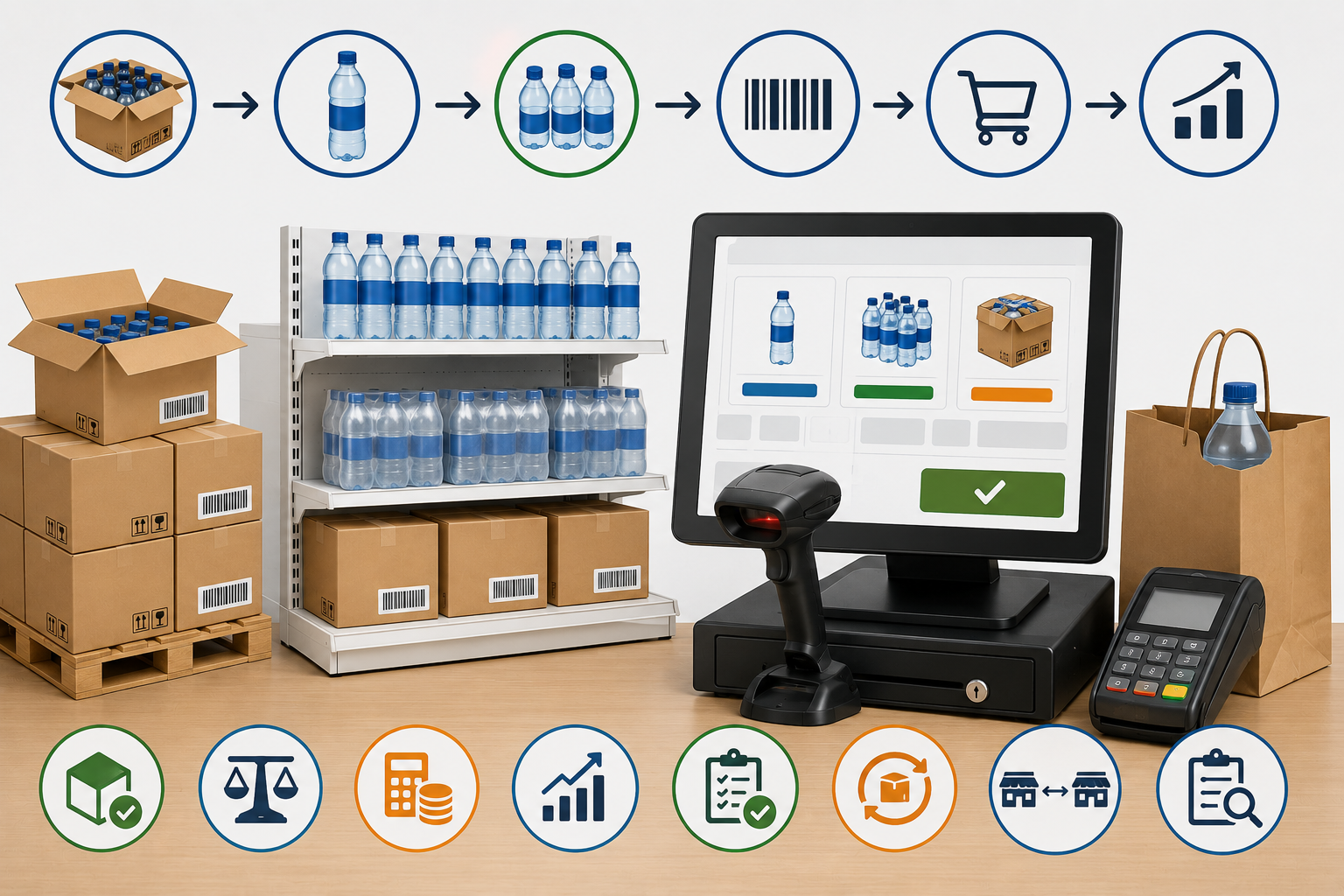
You Bought a Case of 24 but Sold One Bottle: How POS Units of Measure Prevent Inventory and Pricing Errors
Retailers often buy products by case, receive them by pack, and sell them individually. Learn how POS unit-of-measure rules, barcode mapping, cost conversion, stock counts, returns, and purchasing controls prevent quantity and margin errors.
Read article