
The Register Is Short—But Where Did the Money Go? A Practical POS Guide to Cash Drawers and Payment Reconciliation
A cash difference at closing does not automatically mean theft. Learn how POS register sessions, floats, paid-in and paid-out movements, refunds, tips, card settlements, and clear accountability help retailers reconcile every payment method.

The Register Is Short—But Where Did the Money Go? A Practical POS Guide to Cash Drawers and Payment Reconciliation
A cash difference at closing does not automatically mean theft. Learn how POS register sessions, floats, paid-in and paid-out movements, refunds, tips, card settlements, and clear accountability help retailers reconcile every payment method.
A Cash Difference Is a Symptom, Not a Verdict
A drawer that closes twenty dollars short can reflect theft, but it can also reflect incorrect change, a cash sale never entered in the POS, a refund recorded against the wrong tender, a paid-out expense without a record, the wrong opening float, money placed in another drawer, or a counting mistake.
The difference is a signal to investigate. Treating it as proof of misconduct before reviewing the transaction trail damages trust and often leaves the real process problem untouched.
For example, A drawer that closes twenty dollars short can reflect theft, but it can also reflect incorrect change, a cash sale never entered in the POS, a refund recorded against the wrong tender, a paid-out expense without a record, the wrong opening float, money placed in another drawer, or a counting mistake. When shifts change, the store should either close and count the session or record a controlled transfer of responsibility. One drawer used by many people all day makes the final difference difficult to explain. The correction should improve the process, preserve a clear audit trail, and avoid adjusting the balance without explaining the cause.
Every Drawer Needs a Defined Session
A register session should have a location, device or drawer, responsible employee, opening time, starting float, closing time, expected amount, counted amount, and variance. Shared drawers without clear handover make accountability weak.
When shifts change, the store should either close and count the session or record a controlled transfer of responsibility. One drawer used by many people all day makes the final difference difficult to explain.
For example, When shifts change, the store should either close and count the session or record a controlled transfer of responsibility. One drawer used by many people all day makes the final difference difficult to explain. Card sales are authorized at checkout, but settlement and bank funding can arrive later. Fees, refunds, chargebacks, tips, batch cut-off times, holidays, and payment-provider reserves can make the bank deposit differ from the POS total. The correction should improve the process, preserve a clear audit trail, and avoid adjusting the balance without explaining the cause.
Expected Cash Only Works When Every Movement Is Recorded
Expected cash is a formula: opening float plus cash sales and cash added, minus cash refunds and approved cash removed. The formula fails when staff open the drawer, pay a supplier, create change, remove excess cash, or correct a mistake without recording the reason.
Every paid-in and paid-out movement needs amount, reason, time, user, approval where necessary, and supporting evidence. The system should also record drawer openings that occur without a sale.
For example, The difference is a signal to investigate. Treating it as proof of misconduct before reviewing the transaction trail damages trust and often leaves the real process problem untouched. One small variance may be a human error. Repeated shortages on the same shift, drawer, employee, payment type, or transaction pattern require deeper review. Repeated overages also indicate a problem because customers may have received incorrect change. The correction should improve the process, preserve a clear audit trail, and avoid adjusting the balance without explaining the cause.
Card Sales and Bank Deposits Follow Different Timelines
Card sales are authorized at checkout, but settlement and bank funding can arrive later. Fees, refunds, chargebacks, tips, batch cut-off times, holidays, and payment-provider reserves can make the bank deposit differ from the POS total.
Reconcile by payment provider, batch, settlement date, transaction date, gross amount, refund, fee, chargeback, and net deposit. Do not compare one day’s card sales directly with one bank line without considering timing.
For example, Expected cash is a formula: opening float plus cash sales and cash added, minus cash refunds and approved cash removed. The formula fails when staff open the drawer, pay a supplier, create change, remove excess cash, or correct a mistake without recording the reason. Dashierly or any POS should connect register sessions, employees, cash activity, refunds, payment types, card settlements, branches, and audit history. Reconciliation turns daily payment activity into numbers that operations and finance can both trust. The correction should improve the process, preserve a clear audit trail, and avoid adjusting the balance without explaining the cause.
Investigate Patterns Instead of Blaming the Last Cashier
One small variance may be a human error. Repeated shortages on the same shift, drawer, employee, payment type, or transaction pattern require deeper review. Repeated overages also indicate a problem because customers may have received incorrect change.
Use audit logs, voids, refunds, no-sale openings, manual discounts, cancelled payments, shift handovers, and camera evidence only when proportionate and permitted. The goal is to identify a process or risk pattern, not to create fear.
For example, A register session should have a location, device or drawer, responsible employee, opening time, starting float, closing time, expected amount, counted amount, and variance. Shared drawers without clear handover make accountability weak. The difference is a signal to investigate. Treating it as proof of misconduct before reviewing the transaction trail damages trust and often leaves the real process problem untouched. The correction should improve the process, preserve a clear audit trail, and avoid adjusting the balance without explaining the cause.
Build a Closing Process That Finance Can Trust
A trusted close begins before the store shuts: verify open orders, record cash movements, close payment batches, count away from interruptions, use denomination counts, compare expected and actual, document variance, obtain approval, and secure the deposit.
Dashierly or any POS should connect register sessions, employees, cash activity, refunds, payment types, card settlements, branches, and audit history. Reconciliation turns daily payment activity into numbers that operations and finance can both trust.
For example, Every paid-in and paid-out movement needs amount, reason, time, user, approval where necessary, and supporting evidence. The system should also record drawer openings that occur without a sale. Expected cash is a formula: opening float plus cash sales and cash added, minus cash refunds and approved cash removed. The formula fails when staff open the drawer, pay a supplier, create change, remove excess cash, or correct a mistake without recording the reason. The correction should improve the process, preserve a clear audit trail, and avoid adjusting the balance without explaining the cause.
Keep reading
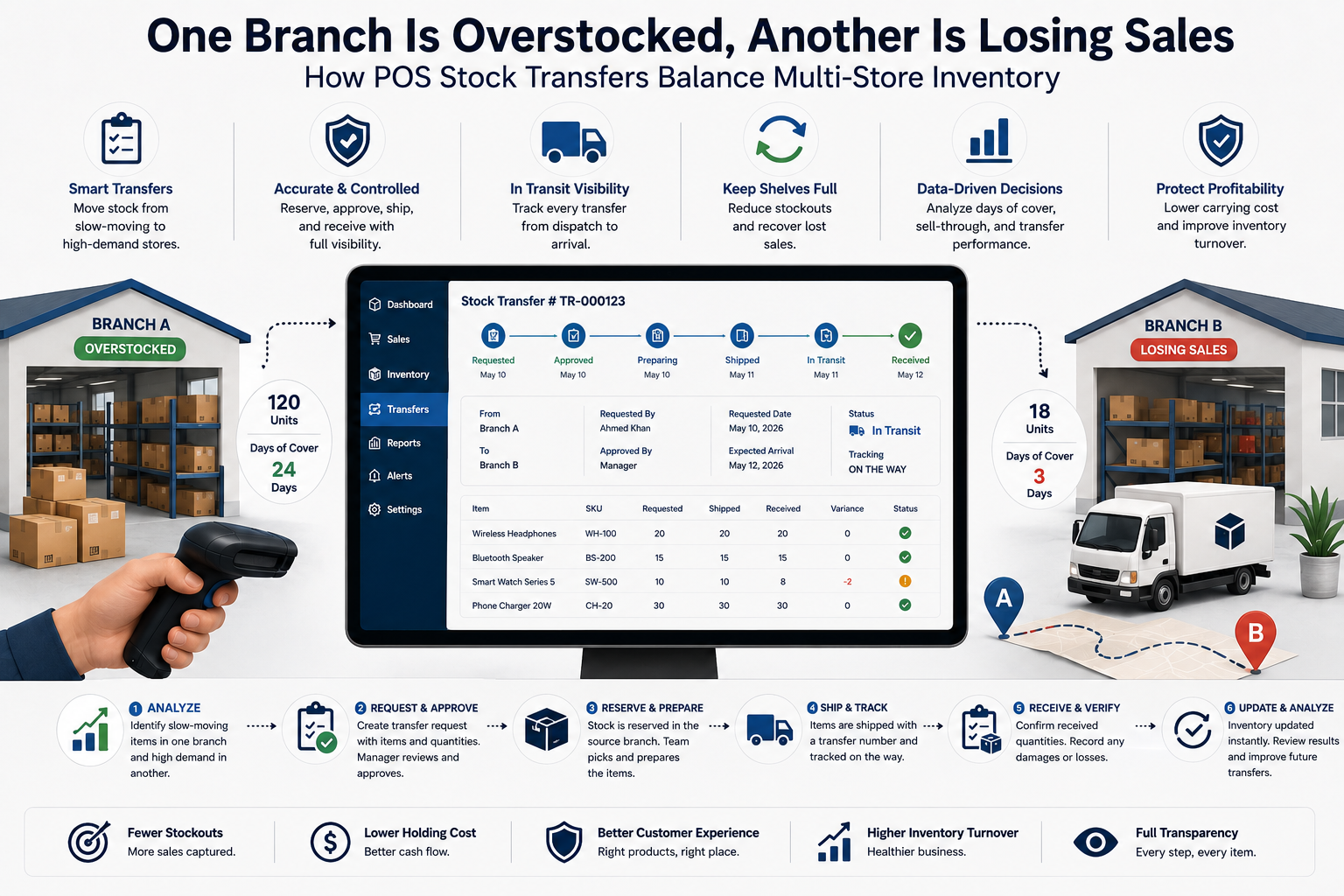
One Branch Is Overstocked, Another Is Losing Sales: How POS Stock Transfers Balance Multi-Store Inventory
Moving stock between branches looks simple, but poor transfer control creates phantom inventory, duplicate availability, missing cartons, delayed receiving, and unreliable reports. Learn how a modern POS should request, ship, receive, reconcile, and analyze inter-branch transfers.
Read article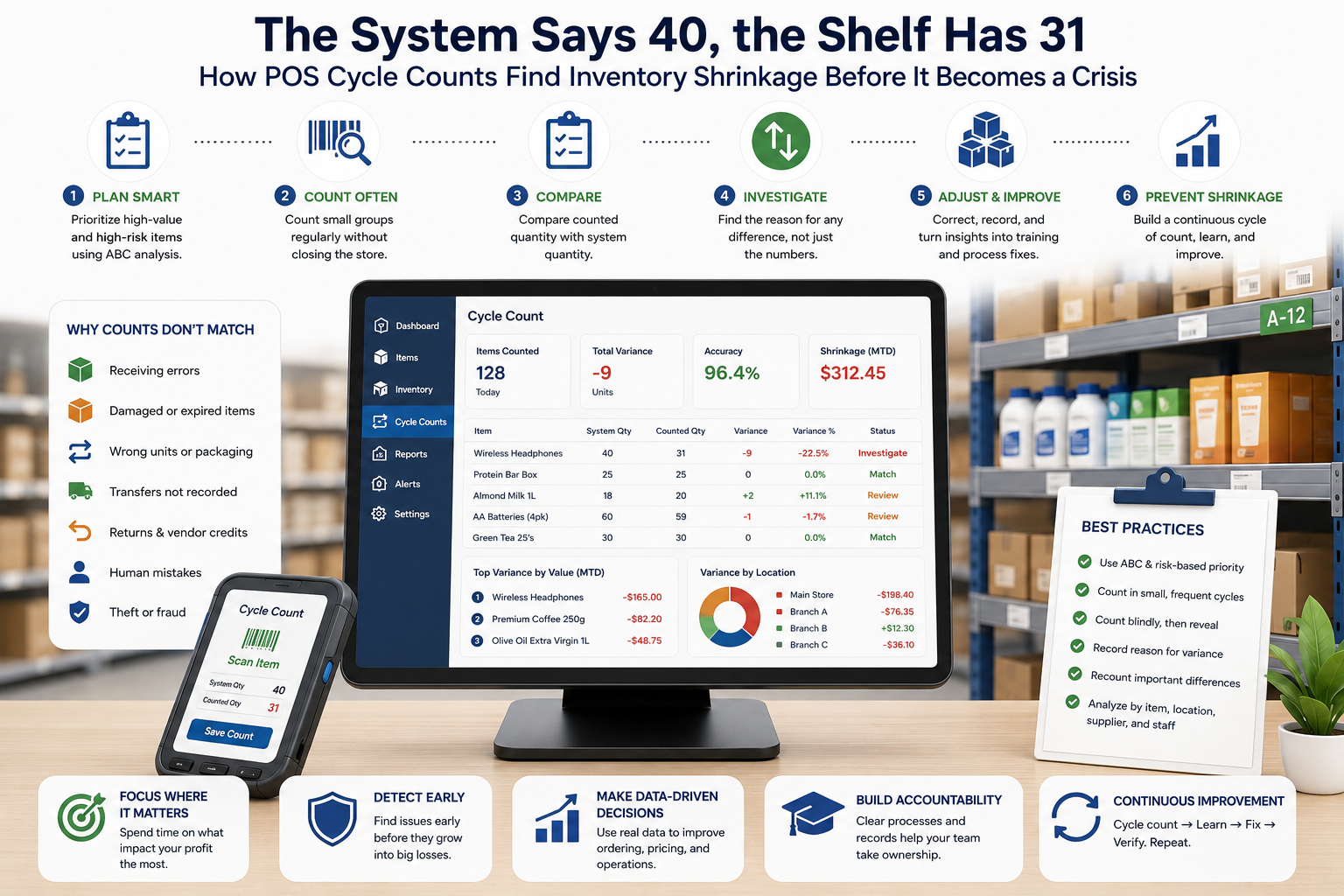
The System Says 40, the Shelf Has 31: How POS Cycle Counts Find Inventory Shrinkage Before It Becomes a Crisis
Inventory discrepancies rarely appear all at once. They build through receiving mistakes, unrecorded damage, wrong units, theft, transfers, returns, and stock adjustments. Learn how POS cycle counts, variance analysis, and root-cause workflows restore accuracy without closing the entire store.
Read article
Your Warehouse Is Full, but the Best Sellers Are Missing: How POS Data Fixes Replenishment and Dead Stock
A full warehouse does not mean healthy inventory. Learn how POS sales velocity, lead time, seasonality, reorder points, supplier performance, transfers, and dead-stock analysis help retailers buy the right products at the right time.
Read article