
Stop Rewarding Every Sale the Same Way: How POS Data Builds Customer Loyalty Without Destroying Margin
Points and discounts do not automatically create loyalty. Learn how POS customer data, purchase history, visit frequency, product preferences, and relevant rewards can improve retention without training shoppers to wait for promotions.
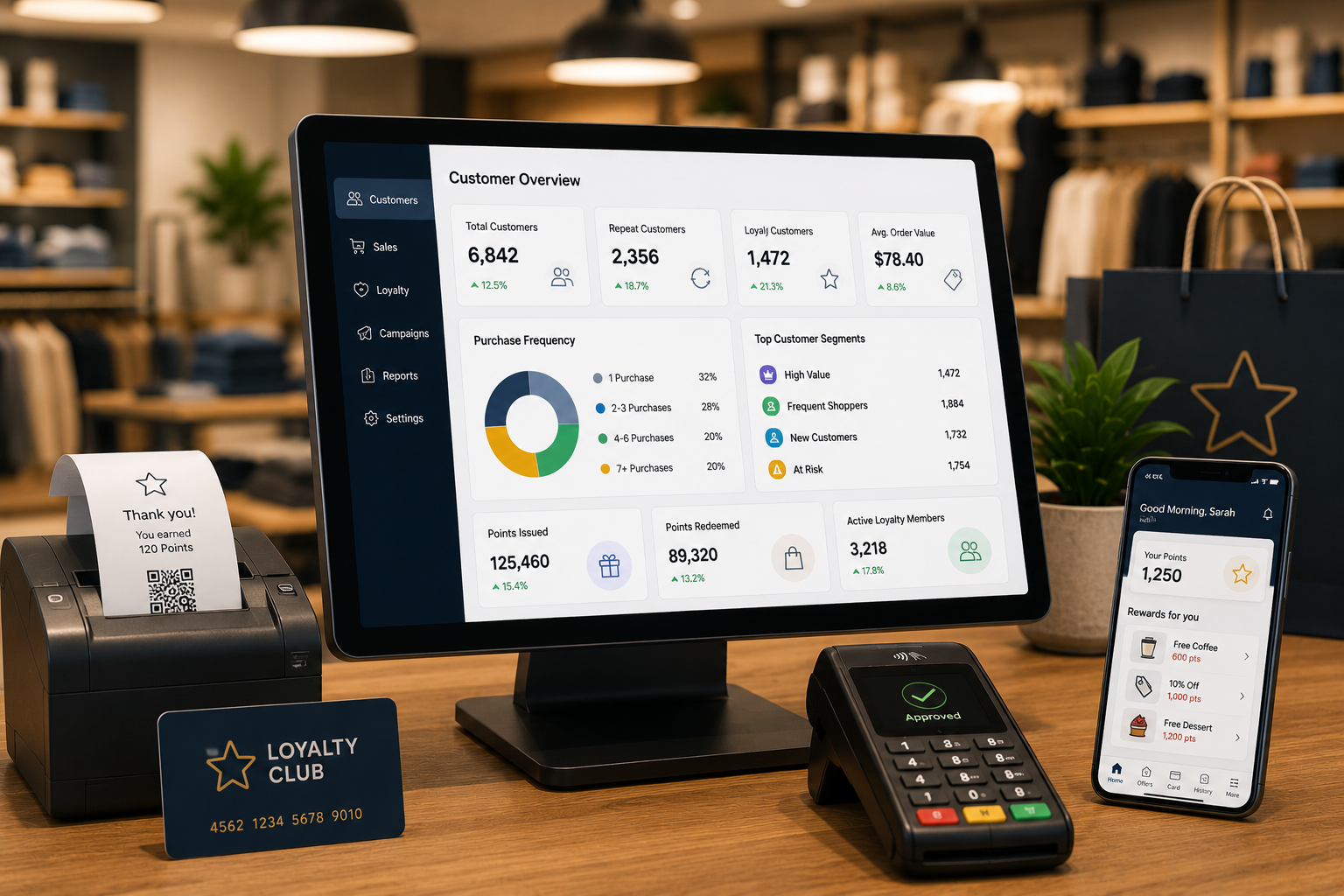
Stop Rewarding Every Sale the Same Way: How POS Data Builds Customer Loyalty Without Destroying Margin
Points and discounts do not automatically create loyalty. Learn how POS customer data, purchase history, visit frequency, product preferences, and relevant rewards can improve retention without training shoppers to wait for promotions.
Loyalty Is a Behaviour, Not a Membership Card
A loyalty program can have thousands of registered members and still fail. If most members never identify themselves at checkout, rarely return, or only buy when a coupon appears, the business has created a database rather than loyalty.
Real loyalty is visible in behaviour: shorter time between visits, repeat purchase of relevant categories, greater trust in the store, willingness to try a recommendation, lower churn, and a relationship that survives when no promotion is running.
For example, A loyalty program can have thousands of registered members and still fail. If most members never identify themselves at checkout, rarely return, or only buy when a coupon appears, the business has created a database rather than loyalty. The system should explain why identification benefits the customer. Digital receipts, easier returns, warranty records, saved preferences, relevant rewards, and access to purchase history are often more persuasive than a generic promise of points. The action should be tested against a clear baseline so the retailer can see whether it changed behaviour or only reduced the price.
The POS Must Identify the Customer Without Slowing Checkout
The POS is where online promises meet the physical store. Customer identification must be fast and optional: phone number, QR code, account lookup, app, receipt link, or another consented method. A cashier should not have to complete a long registration while a queue grows.
The system should explain why identification benefits the customer. Digital receipts, easier returns, warranty records, saved preferences, relevant rewards, and access to purchase history are often more persuasive than a generic promise of points.
For example, The system should explain why identification benefits the customer. Digital receipts, easier returns, warranty records, saved preferences, relevant rewards, and access to purchase history are often more persuasive than a generic promise of points. Blanket discounts train customers to wait and reduce margin on purchases that would have happened anyway. Better rewards include early access, free service, extended returns, reserved stock, priority support, a relevant sample, a bundle, a birthday benefit, or a threshold reward with controlled cost. The action should be tested against a clear baseline so the retailer can see whether it changed behaviour or only reduced the price.
Useful Personalization Begins with Simple Signals
Personalization does not require an advanced AI project on day one. Start with recency, frequency, average spend, preferred categories, usual branch, typical purchase interval, return behaviour, and response to previous offers.
A customer who buys the same consumable every six weeks needs a useful reminder, not a random discount on an unrelated category. A new customer may need education. A high-value customer with falling frequency may need service recovery rather than another coupon.
For example, Real loyalty is visible in behaviour: shorter time between visits, repeat purchase of relevant categories, greater trust in the store, willingness to try a recommendation, lower churn, and a relationship that survives when no promotion is running. Enrollment is only the beginning. Measure identification rate at the POS, active member rate, repeat purchase rate, visit frequency, average time between purchases, redemption, churn, customer lifetime value, margin after rewards, and the percentage of offers that caused incremental behaviour. The action should be tested against a clear baseline so the retailer can see whether it changed behaviour or only reduced the price.
Rewards Should Protect Margin and Feel Valuable
Blanket discounts train customers to wait and reduce margin on purchases that would have happened anyway. Better rewards include early access, free service, extended returns, reserved stock, priority support, a relevant sample, a bundle, a birthday benefit, or a threshold reward with controlled cost.
The value perceived by the customer can be higher than the cost to the retailer. A low-cost convenience, recognition, or service benefit may create more loyalty than a repeated percentage discount.
For example, Personalization does not require an advanced AI project on day one. Start with recency, frequency, average spend, preferred categories, usual branch, typical purchase interval, return behaviour, and response to previous offers. A good loyalty system does not simply give away value after every transaction. It learns what customers genuinely appreciate, creates reasons to return, protects margin, and helps the store recognize a relationship rather than only a receipt. The action should be tested against a clear baseline so the retailer can see whether it changed behaviour or only reduced the price.
Measure Retention, Not Just Enrollment
Enrollment is only the beginning. Measure identification rate at the POS, active member rate, repeat purchase rate, visit frequency, average time between purchases, redemption, churn, customer lifetime value, margin after rewards, and the percentage of offers that caused incremental behaviour.
Compare members with similar non-members instead of assuming every member sale was created by the program. Review inactive accounts, unused rewards, over-discounted segments, and customers who stopped returning after a poor experience.
Dashierly or any POS should connect customer profiles with sales history, branches, products, returns, invoices, permissions, and reports while respecting consent and limiting unnecessary access to personal data.
A good loyalty system does not simply give away value after every transaction. It learns what customers genuinely appreciate, creates reasons to return, protects margin, and helps the store recognize a relationship rather than only a receipt.
For example, The POS is where online promises meet the physical store. Customer identification must be fast and optional: phone number, QR code, account lookup, app, receipt link, or another consented method. A cashier should not have to complete a long registration while a queue grows. Real loyalty is visible in behaviour: shorter time between visits, repeat purchase of relevant categories, greater trust in the store, willingness to try a recommendation, lower churn, and a relationship that survives when no promotion is running. The action should be tested against a clear baseline so the retailer can see whether it changed behaviour or only reduced the price.
For example, A customer who buys the same consumable every six weeks needs a useful reminder, not a random discount on an unrelated category. A new customer may need education. A high-value customer with falling frequency may need service recovery rather than another coupon. Personalization does not require an advanced AI project on day one. Start with recency, frequency, average spend, preferred categories, usual branch, typical purchase interval, return behaviour, and response to previous offers. The action should be tested against a clear baseline so the retailer can see whether it changed behaviour or only reduced the price.
Keep reading
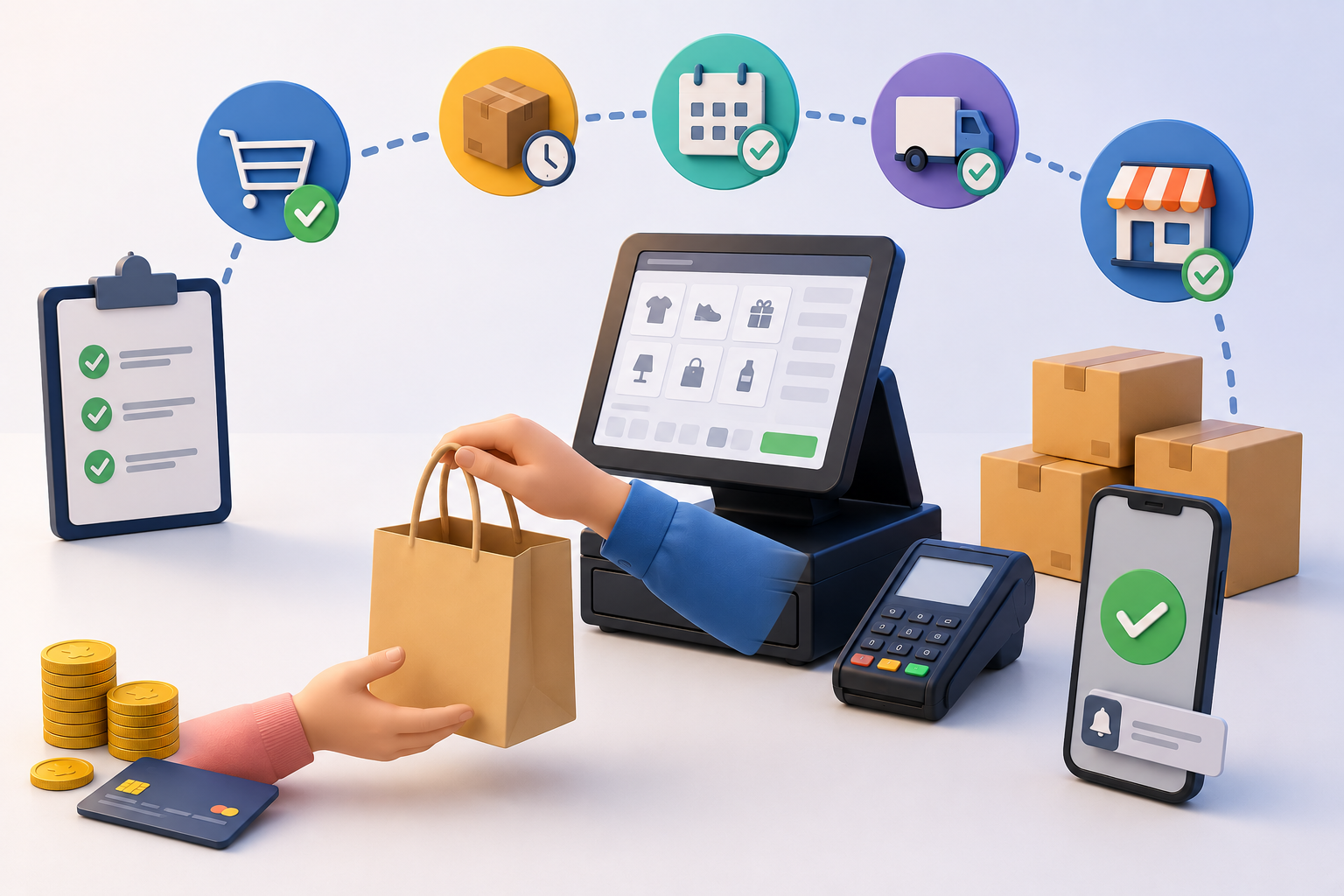
The Customer Paid a Deposit, but the Sale Is Not Finished: How POS Systems Should Manage Preorders, Layaway, and Partial Payments
Deposits, preorders, layaway, special orders, and partial payments can secure demand and improve cash flow—but only when inventory, customer balances, due dates, refunds, and accounting stay connected. Learn how a modern POS should manage the entire order lifecycle.
Read article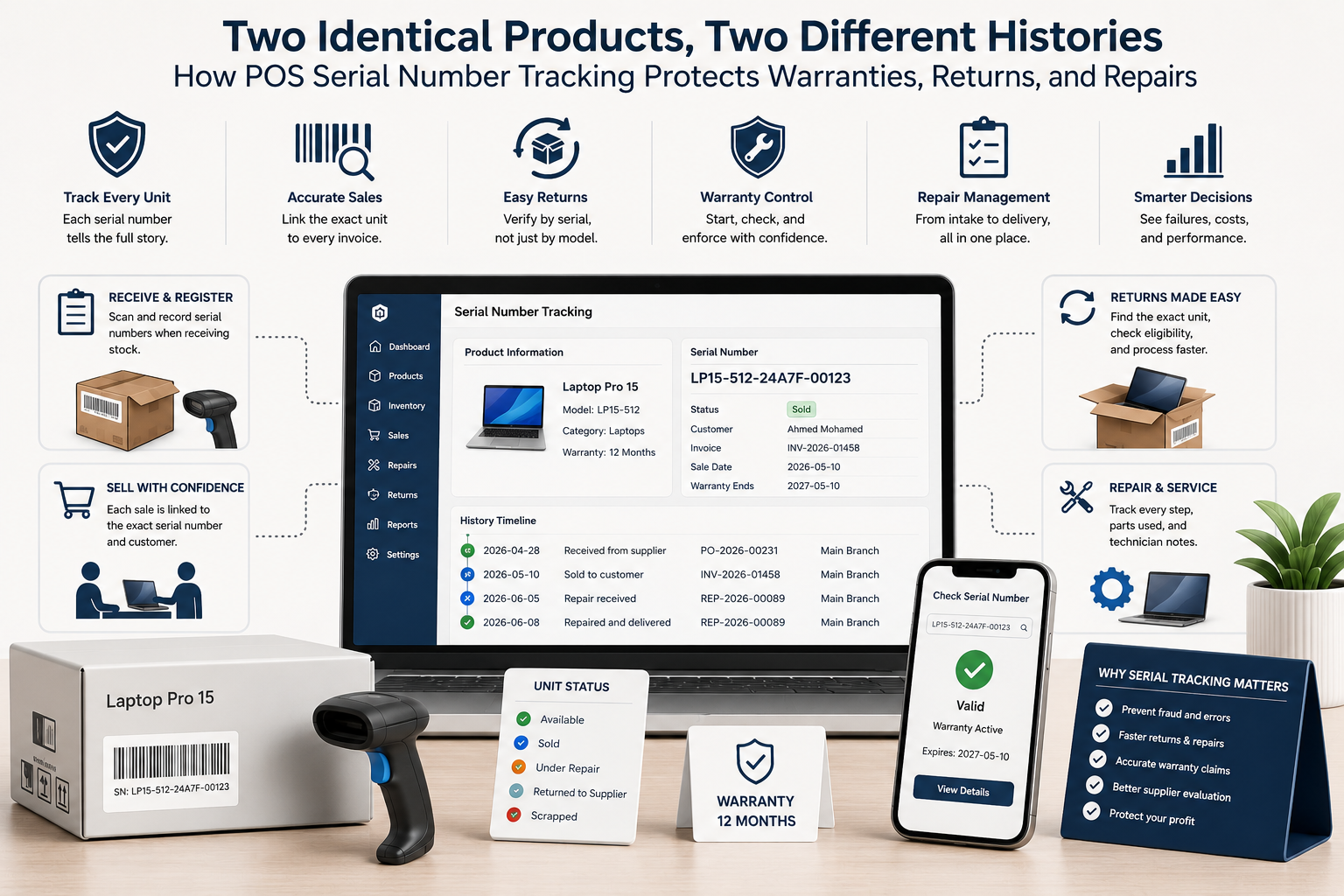
Two Identical Products, Two Different Histories: How POS Serial Number Tracking Protects Warranties, Returns, and Repairs
Quantity tracking tells you how many units exist. Serial tracking tells you exactly which unit was received, sold, returned, repaired, replaced, or still covered by warranty. Learn how a modern POS should manage serialized inventory from supplier receipt to after-sales service.
Read article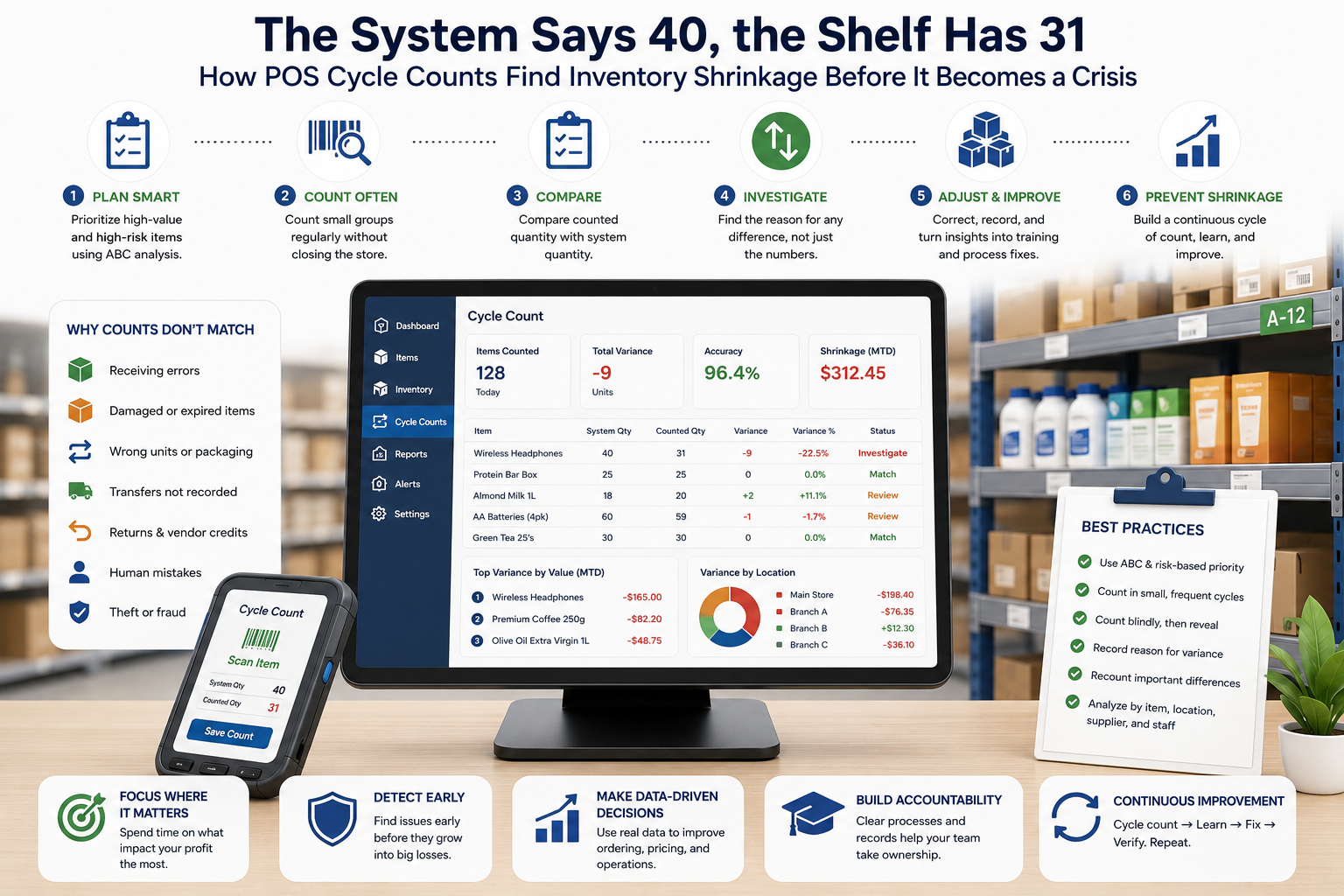
The System Says 40, the Shelf Has 31: How POS Cycle Counts Find Inventory Shrinkage Before It Becomes a Crisis
Inventory discrepancies rarely appear all at once. They build through receiving mistakes, unrecorded damage, wrong units, theft, transfers, returns, and stock adjustments. Learn how POS cycle counts, variance analysis, and root-cause workflows restore accuracy without closing the entire store.
Read article