
When the Wi-Fi Dies, Can Your Store Keep Selling? A Practical Guide to Offline POS and Retail Resilience in 2026
Learn how offline POS, local data, resilient payments, safe synchronization, backups, and clear staff procedures help stores continue selling during internet, cloud, power, and payment outages.
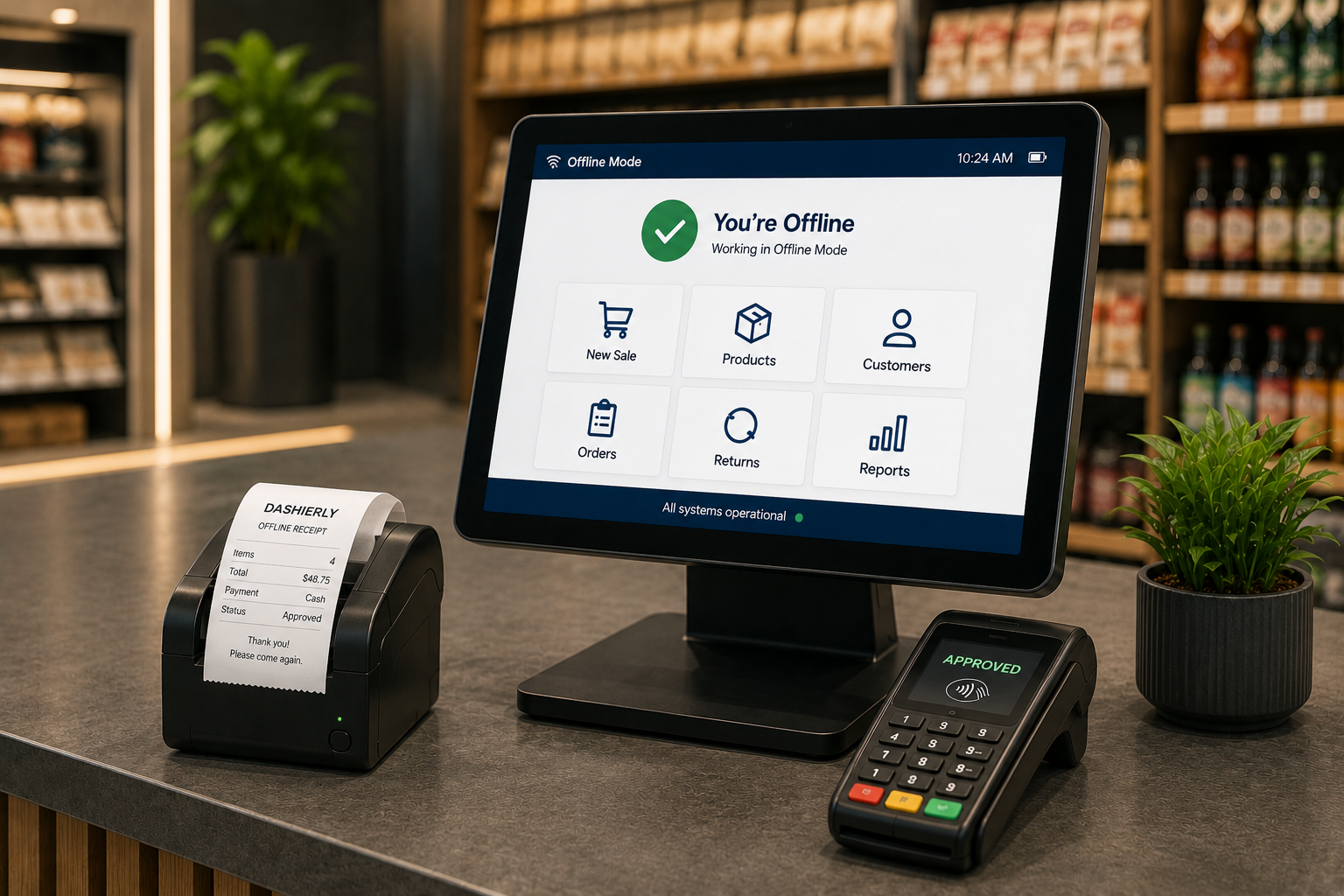
When the Wi-Fi Dies, Can Your Store Keep Selling? A Practical Guide to Offline POS and Retail Resilience in 2026
Learn how offline POS, local data, resilient payments, safe synchronization, backups, and clear staff procedures help stores continue selling during internet, cloud, power, and payment outages.
An Outage Is Not One Problem
At 8:05 p.m., the store is full, the card terminal stops responding, the cloud dashboard will not load, and the manager cannot tell whether the problem is the internet, the payment provider, the local router, or the POS vendor. Customers see only one thing: the shop cannot take their money.
A resilient store separates failures. Internet loss, payment-network failure, cloud outage, local device failure, power interruption, and synchronization delay require different responses. Treating every incident as “the Wi-Fi is down” wastes time and often makes recovery worse.
What a Real Offline POS Must Keep Working
A true offline mode should preserve the product catalogue, prices, taxes, user permissions, receipt numbering, customer-neutral sales, cash transactions, supported offline payments, local stock movements, returns policy, and a protected transaction queue.
Offline does not mean every feature remains available. Loyalty balances, gift cards, real-time branch stock, online orders, complex promotions, remote approvals, and some payment types may need restrictions. The system should state clearly what works, what pauses, and what becomes risky.
Document exactly which functions are available in offline mode. A vague promise is dangerous because employees may assume a refund, loyalty redemption, stock transfer, or gift card will work when it cannot.
Record the cause and duration of every outage, sales affected, transactions queued, payments declined, manual work, and recovery time. Improvement needs evidence.
Document exactly which functions are available in offline mode. A vague promise is dangerous because employees may assume a refund, loyalty redemption, stock transfer, or gift card will work when it cannot.
Record the cause and duration of every outage, sales affected, transactions queued, payments declined, manual work, and recovery time. Improvement needs evidence.
Offline Payments Need Risk Rules
Card payments are the hardest part because authorization normally depends on external networks. A retailer may allow small offline transactions within limits, restrict high-risk cards, require a floor limit, or switch to cash and alternative approved methods.
Risk rules should consider transaction value, repeated attempts, card type, staff role, store history, and how long the outage has lasted. Continuing every payment without control can turn resilience into fraud and chargebacks.
Protect local data with device encryption, automatic lock, named accounts, limited permissions, and secure deletion when equipment is replaced.
Customer communication should be calm and specific: which methods work, whether receipts are available, whether returns are paused, and how long the team expects the limitation to last.
Protect local data with device encryption, automatic lock, named accounts, limited permissions, and secure deletion when equipment is replaced.
Customer communication should be calm and specific: which methods work, whether receipts are available, whether returns are paused, and how long the team expects the limitation to last.
Synchronization Is Where Resilience Is Proven
When connectivity returns, queued sales must synchronize without duplication. Product quantities, invoice numbers, payments, returns, customer records, and branch totals can conflict if two devices changed the same data while disconnected.
Good synchronization uses unique transaction IDs, timestamps, conflict rules, retry logic, visible status, encryption, and a reconciliation report. Staff should know which transactions are pending and which require human review.
Give every queued transaction a visible state such as local, pending, synchronized, rejected, or needs review. Hidden queues create double entry and customer disputes.
Do not let staff create handwritten sales outside the system unless a documented emergency process explains numbering, pricing, tax, payment, and later entry.
Give every queued transaction a visible state such as local, pending, synchronized, rejected, or needs review. Hidden queues create double entry and customer disputes.
Do not let staff create handwritten sales outside the system unless a documented emergency process explains numbering, pricing, tax, payment, and later entry.
Staff Procedures Matter as Much as Architecture
A technically resilient POS can still fail if employees do not know what to do. They need a short outage checklist: confirm scope, notify a manager, switch to approved mode, explain the situation to customers, record exceptions, and avoid improvised workarounds.
Printed emergency instructions, backup connectivity, charged mobile devices, spare receipt paper, tested cash procedures, support contacts, and defined approval limits often matter more than another dashboard.
Decide how long the store can operate offline. A ten-minute interruption and an eight-hour outage need different limits, staffing, reconciliation, and customer communication.
Recovery is not complete when the screen turns green. It is complete when sales, inventory, payments, taxes, receipts, and accounts reconcile.
Decide how long the store can operate offline. A ten-minute interruption and an eight-hour outage need different limits, staffing, reconciliation, and customer communication.
Recovery is not complete when the screen turns green. It is complete when sales, inventory, payments, taxes, receipts, and accounts reconcile.
A Practical Continuity Test for Every Store
Run a quarterly test during a quiet period. Disconnect the internet, simulate payment failure, complete cash and permitted offline sales, restart a device, restore connectivity, and verify every transaction, receipt, stock movement, and accounting total.
Dashierly or any POS should be evaluated not only when everything is online, but during failure and recovery. The strongest system is not the one that promises zero outages. It is the one that fails in a controlled, visible, and recoverable way.
Use a secondary connection only after testing automatic failover. A mobile hotspot that requires a forgotten password is not a continuity plan.
Keep cash as a planned option where legally and operationally possible. Cash procedures require change, secure storage, counting, and end-of-day reconciliation.
Test devices independently. One functioning till can preserve a store, while a shared local server or router can become a single point of failure.
A resilient POS combines cloud convenience with local operational capability. The design goal is controlled degradation rather than an all-or-nothing shutdown.
Use a secondary connection only after testing automatic failover. A mobile hotspot that requires a forgotten password is not a continuity plan.
Keep cash as a planned option where legally and operationally possible. Cash procedures require change, secure storage, counting, and end-of-day reconciliation.
Test devices independently. One functioning till can preserve a store, while a shared local server or router can become a single point of failure.
A resilient POS combines cloud convenience with local operational capability. The design goal is controlled degradation rather than an all-or-nothing shutdown.
Keep reading
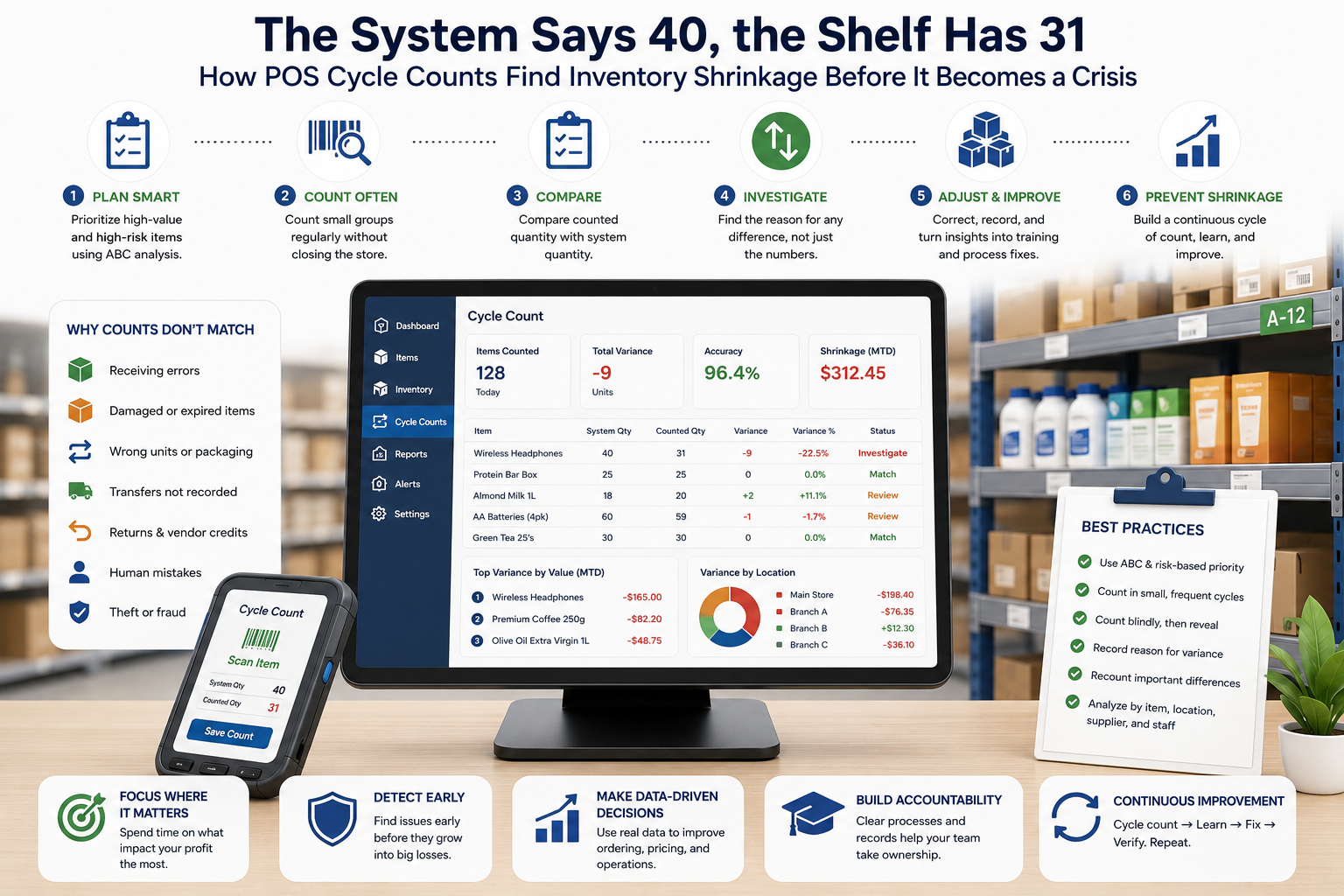
The System Says 40, the Shelf Has 31: How POS Cycle Counts Find Inventory Shrinkage Before It Becomes a Crisis
Inventory discrepancies rarely appear all at once. They build through receiving mistakes, unrecorded damage, wrong units, theft, transfers, returns, and stock adjustments. Learn how POS cycle counts, variance analysis, and root-cause workflows restore accuracy without closing the entire store.
Read article
Your Warehouse Is Full, but the Best Sellers Are Missing: How POS Data Fixes Replenishment and Dead Stock
A full warehouse does not mean healthy inventory. Learn how POS sales velocity, lead time, seasonality, reorder points, supplier performance, transfers, and dead-stock analysis help retailers buy the right products at the right time.
Read article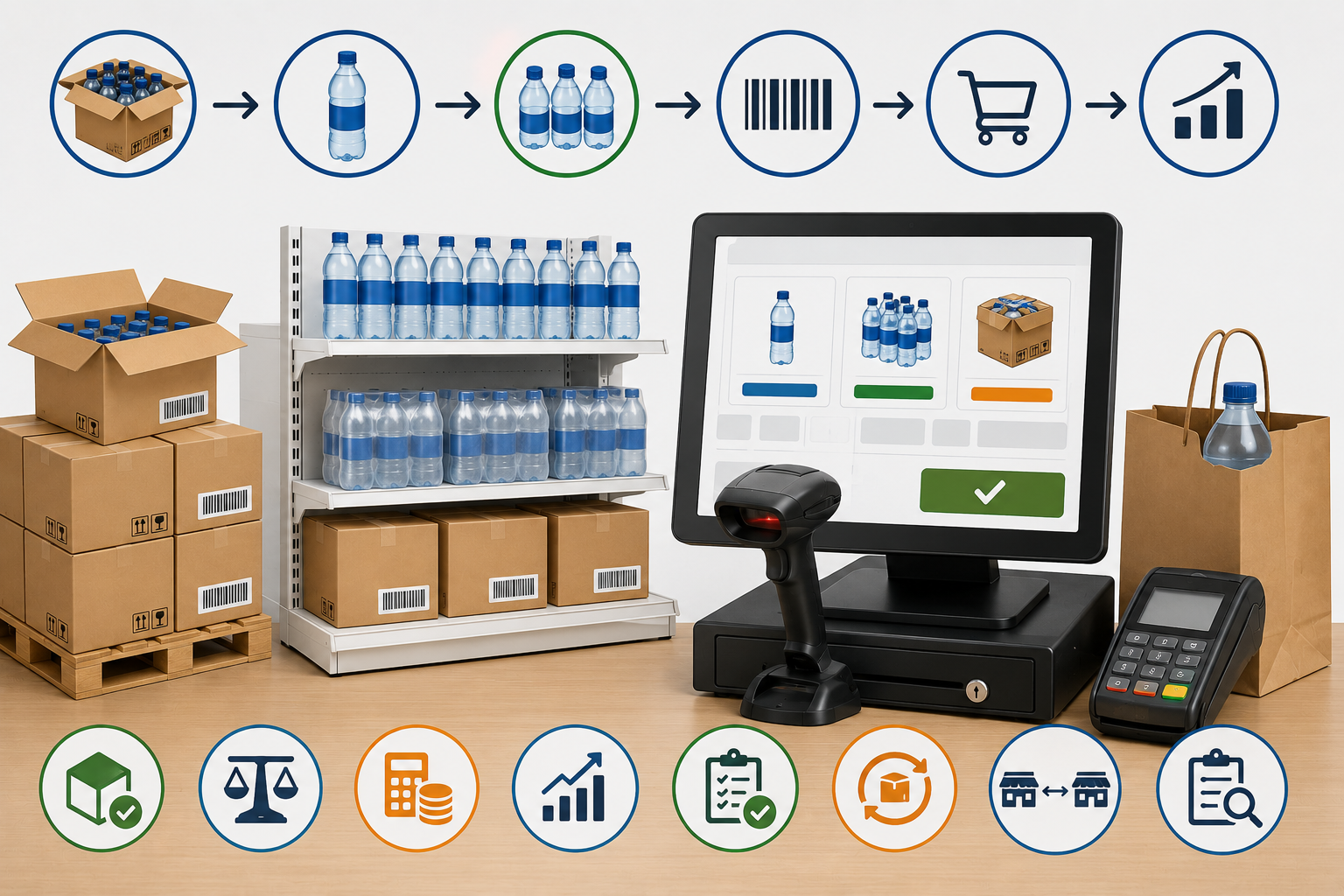
You Bought a Case of 24 but Sold One Bottle: How POS Units of Measure Prevent Inventory and Pricing Errors
Retailers often buy products by case, receive them by pack, and sell them individually. Learn how POS unit-of-measure rules, barcode mapping, cost conversion, stock counts, returns, and purchasing controls prevent quantity and margin errors.
Read article