
Tu inventario no se equivoca por casualidad: datos de producto, códigos de barras y variantes en el POS
Los errores de inventario suelen empezar antes de vender. Aprende cómo SKU duplicados, códigos compartidos, unidades, variantes y packs generan diferencias.
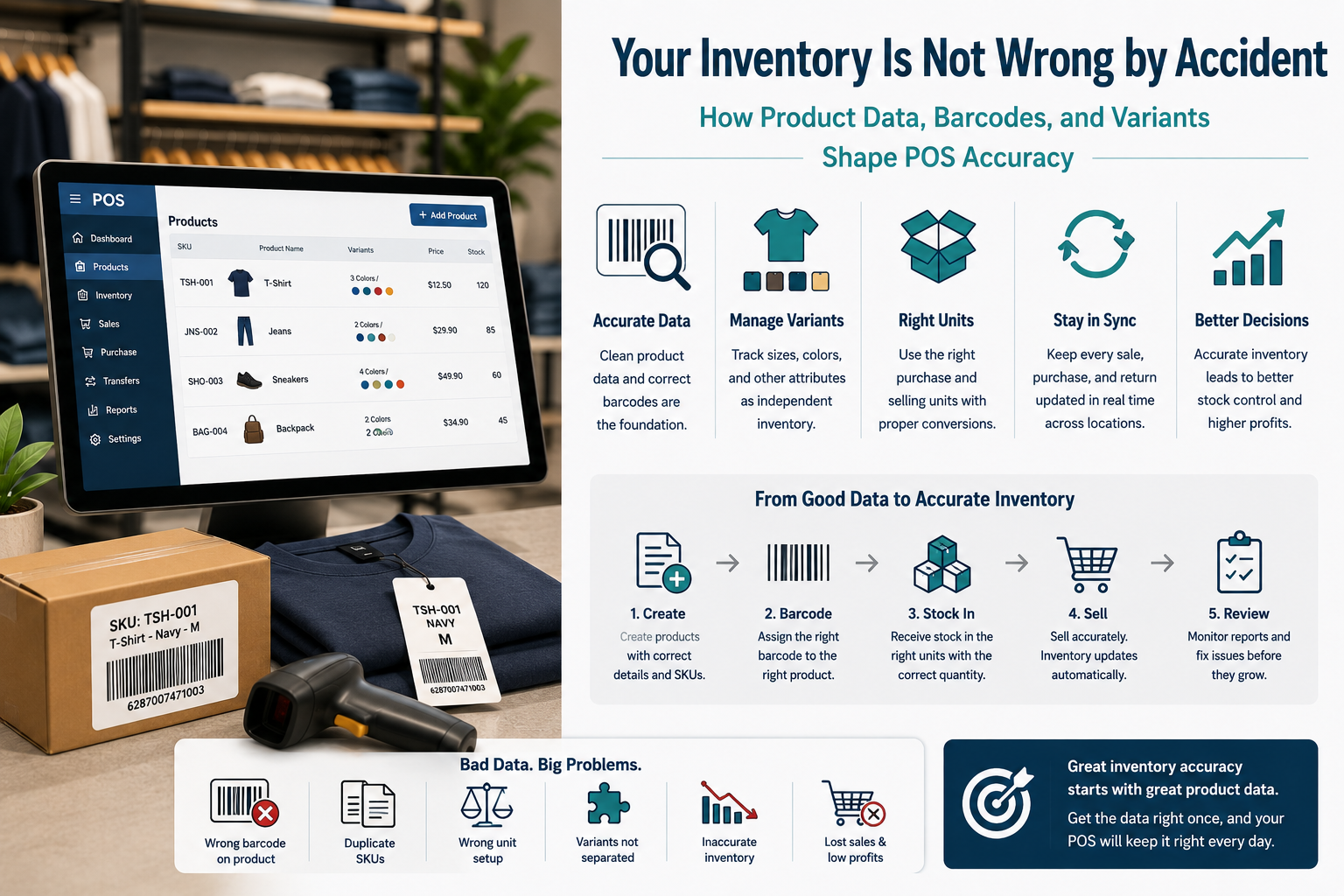
Tu inventario no se equivoca por casualidad: datos de producto, códigos de barras y variantes en el POS
Los errores de inventario suelen empezar antes de vender. Aprende cómo SKU duplicados, códigos compartidos, unidades, variantes y packs generan diferencias.
El error suele empezar en el catálogo
Inventory differences are often created before checkout by duplicate items, wrong barcodes, incorrect units, or returns posted to a generic record.
The product catalogue is operational infrastructure: name, SKU, barcode, category, tax, cost, price, supplier, unit, pack size, variant, and location rules matter.
Por ejemplo, Inventory differences are often created before checkout by duplicate items, wrong barcodes, incorrect units, or returns posted to a generic record. An item can legitimately have several scannable codes, but they should all resolve to one clear product or variation identity. La corrección debe cambiar el dato maestro o el proceso, no solo la cantidad.
Por ejemplo, Purchasing units, selling units, and conversion factors must be explicit and controlled. A barcode only points the POS to a record. It does not prove that the record or mapping is correct. La corrección debe cambiar el dato maestro o el proceso, no solo la cantidad.
Por ejemplo, A barcode only points the POS to a record. It does not prove that the record or mapping is correct. The product catalogue is operational infrastructure: name, SKU, barcode, category, tax, cost, price, supplier, unit, pack size, variant, and location rules matter. La corrección debe cambiar el dato maestro o el proceso, no solo la cantidad.
El código identifica, no es el producto
A barcode only points the POS to a record. It does not prove that the record or mapping is correct.
An item can legitimately have several scannable codes, but they should all resolve to one clear product or variation identity.
Por ejemplo, An item can legitimately have several scannable codes, but they should all resolve to one clear product or variation identity. Receiving a case as one piece when the store sells individual units creates an immediate inventory error. La corrección debe cambiar el dato maestro o el proceso, no solo la cantidad.
Por ejemplo, Product creation and editing need ownership, required fields, duplicate checks, naming rules, barcode validation, and approval. The parent product groups the family, while the exact variant should hold SKU, barcode, cost, price, reorder point, and status. La corrección debe cambiar el dato maestro o el proceso, no solo la cantidad.
Cada variante necesita identidad propia
Size, colour, material, flavour, and other sellable variants need separate stock quantities and identifiers.
The parent product groups the family, while the exact variant should hold SKU, barcode, cost, price, reorder point, and status.
Por ejemplo, The product catalogue is operational infrastructure: name, SKU, barcode, category, tax, cost, price, supplier, unit, pack size, variant, and location rules matter. A stock count fixes the visible number today but cannot stop bad catalogue data from recreating the problem tomorrow. La corrección debe cambiar el dato maestro o el proceso, no solo la cantidad.
Por ejemplo, A stock count fixes the visible number today but cannot stop bad catalogue data from recreating the problem tomorrow. Purchasing units, selling units, and conversion factors must be explicit and controlled. La corrección debe cambiar el dato maestro o el proceso, no solo la cantidad.
Por ejemplo, An item can legitimately have several scannable codes, but they should all resolve to one clear product or variation identity. Receiving a case as one piece when the store sells individual units creates an immediate inventory error. La corrección debe cambiar el dato maestro o el proceso, no solo la cantidad.
Unidades y packs crean errores costosos
Receiving a case as one piece when the store sells individual units creates an immediate inventory error.
Purchasing units, selling units, and conversion factors must be explicit and controlled.
Por ejemplo, Size, colour, material, flavour, and other sellable variants need separate stock quantities and identifiers. Accurate inventory is built from correctly identified transactions, not from one annual count. La corrección debe cambiar el dato maestro o el proceso, no solo la cantidad.
Por ejemplo, Accurate inventory is built from correctly identified transactions, not from one annual count. Product creation and editing need ownership, required fields, duplicate checks, naming rules, barcode validation, and approval. La corrección debe cambiar el dato maestro o el proceso, no solo la cantidad.
Contar no corrige datos maestros malos
A stock count fixes the visible number today but cannot stop bad catalogue data from recreating the problem tomorrow.
Repeated count differences should be analysed by product, reason, supplier, user, branch, and workflow.
Por ejemplo, A barcode only points the POS to a record. It does not prove that the record or mapping is correct. The product catalogue is operational infrastructure: name, SKU, barcode, category, tax, cost, price, supplier, unit, pack size, variant, and location rules matter. La corrección debe cambiar el dato maestro o el proceso, no solo la cantidad.
Por ejemplo, Receiving a case as one piece when the store sells individual units creates an immediate inventory error. Repeated count differences should be analysed by product, reason, supplier, user, branch, and workflow. La corrección debe cambiar el dato maestro o el proceso, no solo la cantidad.
Por ejemplo, Repeated count differences should be analysed by product, reason, supplier, user, branch, and workflow. Inventory differences are often created before checkout by duplicate items, wrong barcodes, incorrect units, or returns posted to a generic record. La corrección debe cambiar el dato maestro o el proceso, no solo la cantidad.
Por ejemplo, The product catalogue is operational infrastructure: name, SKU, barcode, category, tax, cost, price, supplier, unit, pack size, variant, and location rules matter. A stock count fixes the visible number today but cannot stop bad catalogue data from recreating the problem tomorrow. La corrección debe cambiar el dato maestro o el proceso, no solo la cantidad.
Crea disciplina de datos alrededor del POS
Product creation and editing need ownership, required fields, duplicate checks, naming rules, barcode validation, and approval.
Accurate inventory is built from correctly identified transactions, not from one annual count.
Por ejemplo, The parent product groups the family, while the exact variant should hold SKU, barcode, cost, price, reorder point, and status. Size, colour, material, flavour, and other sellable variants need separate stock quantities and identifiers. La corrección debe cambiar el dato maestro o el proceso, no solo la cantidad.
Por ejemplo, Inventory differences are often created before checkout by duplicate items, wrong barcodes, incorrect units, or returns posted to a generic record. An item can legitimately have several scannable codes, but they should all resolve to one clear product or variation identity. La corrección debe cambiar el dato maestro o el proceso, no solo la cantidad.
Keep reading

La web dice «disponible», pero la estantería está vacía: cómo el POS evita fallos omnicanal
Pedidos online, ventas físicas, reservas, devoluciones y transferencias compiten por las mismas unidades. Aprende a evitar sobreventa y promesas incumplidas.
Leer artículo
La tarjeta regalo se vendió hace meses: ¿por qué sigue siendo una obligación? Valor almacenado en el POS
Las tarjetas regalo generan efectivo anticipado, pero también saldos, obligaciones, fraude, caducidad, pagos divididos, reembolsos y contabilidad.
Leer artículo
¿Quién cambió el precio? Cómo los permisos POS y el registro de auditoría protegen la tienda
Las pérdidas y errores suelen empezar con cuentas compartidas, permisos excesivos y acciones sin trazabilidad. Aprende a usar roles, cuentas personales y aprobaciones.
Leer artículo